Highlights
- Lung cancer isn’t only caused by smoking — environmental exposures are major risks.
- You can take practical steps to reduce your exposure to environmental risks.
- Progress is being made through cleaner technology, early detection and multidisciplinary cancer care.
When thinking about lung cancer, smoking is usually the first risk factor that comes to mind. And you’re right. Smoking accounts for 80% to 90% of all lung cancers, the leading cause of cancer deaths for both men and women.
But a historical decline of smoking among all age groups nationwide is revealing a surprising reality: lung cancer can also affect people who have never smoked. Air pollution (both indoor and outdoor), as well as asbestos and radon, are now considered significant contributors to lung cancer in the United States.
A 2025 National Institutes of Health study of individuals who had never smoked found that fine-particulate air pollution — including pollution from vehicles and industry — is linked with cancer-driving and cancer-promoting genetic mutations. Extreme heat, drought and wildfires all contribute to increased air pollution, exposing a growing number of people to ozone and particle pollution that puts health at risk.
The shift is significant, particularly in urban and industrial areas, says Mark Hennon, MD, FACS, Vice Chair, Department of Thoracic Surgery at Roswell Park and Director of the Thoracic Surgery Training Program at Roswell Park Comprehensive Cancer Center. We all need to breathe air, so what’s a person to do? Learning about your environment and reducing your exposures can help you reduce risks.
Get fresh air outdoors, but pay attention to air quality
“In terms of the air we're breathing, I’m a big proponent of outdoor activities and being in the fresh air unless there are known risk factors that are elevated,” says Dr. Hennon. “Thankfully there’s an awareness about air quality on a national level and, over decades, legislation has addressed major pollutants, thanks to the Clean Air Act. If you are in high-traffic areas or the path of wildfire smoke where there’s likely to be greater than normal pollution levels, an N95 mask will help filter the air, minimizing your exposure as much as possible.”
If you rely on your smartphone for air quality measures, be warned: those air quality indicators may not be accurate as they rely on third-party data that can lag, use less precise sensors or have localized glitches. You can find the most accurate source of ozone and particle pollution in your area at the Environmental Protection Agency (EPA) website.
Test your home for radon
Radon exposure is the second leading cause of lung cancer, after smoking. This colorless, odorless, radioactive gas forms naturally from the decay of radioactive elements found in soil and rock. Testing can be done by a professional or with home test kits found in hardware stores and online.
The EPA recommends taking steps to lower radon exposure if levels of 4 pCi/L or higher are detected. Unsafe levels can be remedied with a radon extraction system that pulls radon gas from beneath a home's foundation and safely vents it outdoors, preventing it from entering living spaces.
Are you at higher risk for lung cancer?
Not sure how your exposures or smoking history affect you? Roswell Park can help.
Learn where you might have asbestos
Asbestos, a fibrous mineral, was commonly used in home construction materials during the 1940s to 1970s, including insulation, flooring and textured finishes. Exposure — inhaling or swallowing asbestos fibers — is strongly linked to lung cancer, as well as mesothelioma, a cancer of the lining surrounding organs in the chest and abdomen. Risks are further compounded for smokers, who already at higher risk for developing lung cancer. Smokers are 10 times more likely to develop lung cancer from asbestos exposure than non-smokers.
“The good news is that we now use safer building materials and have more stringent building codes,” says Dr. Hennon. “There's increased awareness regarding how to safely manage asbestos removal. If you have an older home or building where asbestos could be present, don't make changes that could disturb it. Repairs and removal need to be handled by a professional. If you live or work in an environment where there is asbestos abatement, you need to practice extreme caution.”
Making progress against lung cancer
With lung cancer on the decline nationally, Dr. Hennon is optimistic. “We’re seeing progress in ways that are moving the needle in the right direction. We have an increasing percentage of electric and hybrid vehicles on the road, reducing air pollution. Walk through any hardware store and you’ll see the noticeable shift of equipment like snow blowers, lawn mowers and leaf blowers that now use electric power. Those are all very positive developments.
“Every time I give a lung cancer presentation, I am reminded that lung cancer statistics are continuing to drop. It’s gratifying to see the impact of early diagnosis, smoking cessation, and pollution levels coming down in the last several decades.”
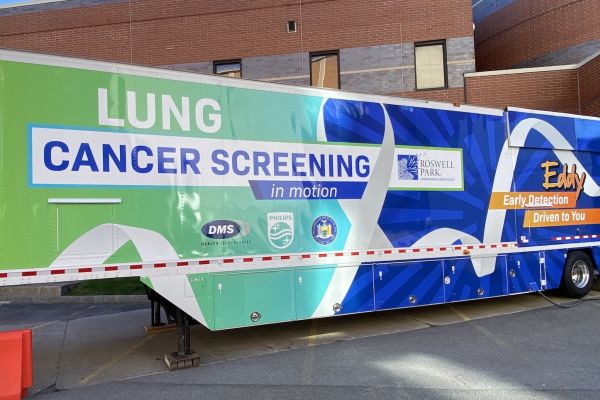
As part of a dedicated team of board-certified specialists who collaboratively review lung tumor and lung nodule cases, Dr. Hennon emphasizes Roswell Park's multidisciplinary approach to diagnosis, comprehensive care and treatment. “Working with a multidisciplinary focus is ingrained in our DNA, so our patients are truly getting the expertise of multiple physicians and experts in all aspects of their care. Patients have access to cutting-edge surgical treatments, clinical trials, and medicines for people with advanced stages of the disease. Outreach programs like our mobile cancer screening centers, EDDY, are achieving earlier detection of lung cancer, which is always our goal.”