David: This is Smarter Than Cancer, and I'm David Hoffman.
Hajar: And I'm Hajar Eldaas
David: And we've covered some really interesting research on this show.
Hajar: Yeah, we really have.
David: But today I'm going to present something that genuinely surprised me when I found out about it.
Hajar: Okay, tell me more.
David: So, it turns out there are serious researchers all around the country, including here at Roswell Park…
Hajar: Mmm-hmm
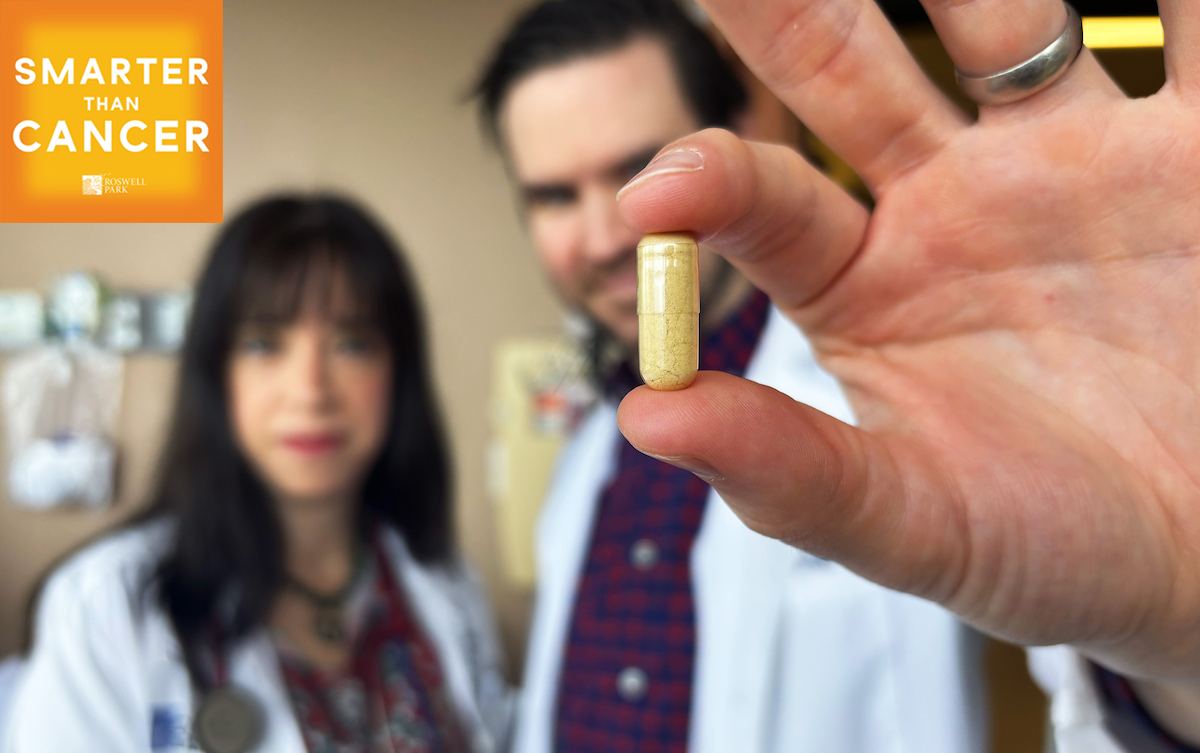
David: …who are doing studies about improving palliative care for cancer patients by using psychedelic drugs.
Hajar: Hmm. When you say psychedelic drugs, you mean…
David: Yeah, like psychedelic drugs!
Hajar: Like LSD?
David: I mean, yes. That's not one we're looking at here, but they are elsewhere.
Hajar: Wow
David: I mean, all of these things that we've sort of stigmatized as hippie dropout kind of things — LSD, DMT, mescaline, magic mushrooms, ketamine — they're all being looked at as really interesting and effective ways to help people through physical pain, and also things like depression, anxiety, trauma.
Hajar: Wow
David: I know, it sounds crazy, and I really wanted to learn more, so I talked to two researchers here: Dr.Amy Case, the chairperson of our Department of Palliative and Supportive Care, and her colleague, Dr. William Alexander, to see how all of this works.
And actually, it ended up making kind of an interesting counterpoint to the conversation I had in the last episode with the psychologist, Dr. Pailer, about the kind of existential distress that cancer patients go through. They're looking at these as a medical way to treat some of the same issues that she's treating through talk therapy.
Hajar: That sounds fascinating. I'm ready to listen.
David: Let's go!
(Theme Music)
David: Here's Dr. Case:
Case: I had requests from patients that were curious about these modalities of treatment because they are being used across the country in cancer patients to treat a variety of symptoms.
And so Dr. Alexander and I, he had a keen interest, and we partnered up and decided we wanted to pursue this and really be the first research team working on this in Western New York. So it's really exciting.
David: Of course, these are modalities of treatment that have a, let's say, complicated history.
People have been using psychedelic drugs for thousands of years. They're part of religious practices that go back to prehistory in places like the American Southwest and the Amazon rainforest
Basically, what they do is they make you hallucinate: see and hear things that aren't there, kind of like a waking dream. And like in a dream, when you're under their influence, you're keyed into your own subconscious, bringing things to mind that you wouldn't normally be actively aware of.
To grossly oversimplify, these religious traditions see this as a way to get in touch with things that are supernatural, spiritual, maybe even sacred
Many people outside these traditions first became aware of these compounds in the middle of the 20th century, when artists and intellectuals began to experimentally self-administer both ancient naturally occurring psychedelics, like mescaline and psilocybin, and also a new breed of synthetic psychedelics, most famously LSD, as part of a kind of New World bohemian spirituality.
Psychedelic drugs soon became totally synonymous with the anti-authoritarian hippie counterculture of the late 1960s, and the government cracked down on them.
By the end of 1970, LSD, psilocybin, and all their cousins were Schedule 1 controlled substances in the United States. Totally illegal to possess or sell
Case: The culture latched on to this new concept, and it kinda ran away with itself, right? So you know some of the things were used in a way that is not as, I guess you would say, conventional research methods, right? and there was also at the same time, the war on drugs, and I think there was a conservative wave to counteract the sixties culture where people were afraid of these new ideas.
So at the end of the day, it was discredited, these new ideas that were coming from these drugs was kind of poo-pooed as a society. It's stigmatized.
David: Some researchers now, though, are looking past that stigma and finding that even in the crazy days of the '60s, there was real clinical value being shown in the careful use of these drugs, and it's research that's worth revisiting and expanding upon.
Here's Dr. Alexander:
Alexander: To give the '60s and, you know…
Case: Yeah
Alexander: …the '50s and '60s it's credit that, you know, there was a lot of wacky stuff going on medically, but they were starting to explore this in a therapeutic medical setting, while in parallel all the other political stuff was also ongoing. And so there is this preliminary data that came out of that that was really promising.
And so now finally, Western medicine is starting to study these things in a rigorous, scientific manner. And so, in our case, we'd be looking at outcomes related to pain. Cancer pain.
David: I know what I want to ask; I'm trying to figure out how to ask it. I will neither confirm nor deny that I have, uh, dabbled in some of these substances in my youth…
(Alexander laughs)
But it was never… I had never did, or did not, approach it, or people I know who've… with the idea that it would be a pleasant or a pain-relieving experience. It was more about sort of opening up new things. Opening your brain in a different way, if that's the right way to look at it. It was often scary. How does that connect to an idea of pain relief?
Alexander: Sure! Yeah. I mean, so our main concern is suffering, and how, when we think about suffering, you know, there's a lot of elements to it. In palliative care, we have this term called “total pain” that kind of captures the multidimensional aspect of pain.
There's your… the physical elements, but there's the psychological, the existential, the spiritual elements as well, that really are kind of intertwined with and often inseparable from physical pain. And so really, we don't have a lot of tools that can address pain at this more fundamental level. And so that's kind of what drew us to psychedelics, is they have a lot of unique properties that can get at some of the roots of suffering.
Case: And so even if you don't have cancer, they can be beneficial for people. It's being used in addiction. It's being used for alcohol use disorder, alcoholism, major depression, anxiety, and things like that, and PTSD for veterans.
So along those same lines, what is the common thread there? The common thread is all of those,diagnoses are associated with trauma.
With these medicines, there's a feeling of connectivity. There's a feeling of oneness. There's a feeling of empathy that comes out. And because of that, we're able to reframe our trauma a little better. And because of that, it can spill over into the physical domain.
David: They also have properties at the molecular level that can impact inflammation, and some of these more biological aspects of physical pain.
Case: And they bind the serotonin receptors, which are the receptors in the brain that help us feel good. Those are the same treatments that are used as antidepressants, and we actually use antidepressants to treat physical pain as well.
Alexander: And so, these substances can act on a lot of different levels: the psychological level, you know, and your ability to cope with it, as well as the biological level.
David: I mean, on a fundamental level, we receive pain psychologically, right? It's processed in the brain. Is there… isn't all pain psychological in a way?
Alexander: I think you're getting at something there.
Case: Bang! (Laughs)
Alexander: Yeah, you're getting at something there. And I just want to add to something else you had said earlier. You described psychedelics as kind of opening you up. Another term that is frequently used to describe the impact of these are just kind of a reset for the brain.
The brain is changed by the experience of chronic pain. And so when people have done MRI studies, some of the networks that are implicated in chronic pain are the exact same networks that are changed and reset or rewired by these psychedelic compounds.
-
One trial we're looking at is psilocybin. It's the active ingredient in magic mushrooms. Psilocybin is what's regarded as a classical psychedelic, meaning it acts on specific serotonin receptors.
We are one of many sites recruiting for this trial. It's for patients who are experiencing symptoms of depression related to their cancer.
David: I'll jump in here to note that many of these compounds are being studied around the country in two different ways. One is low-dose use, or what's sometimes called microdosing. This looks at the effects of these medicines when they're taken frequently over a period of time in doses much lower than those that would create the hallucinogenic effects that we associate with them.
This is not that. In this study, patients are, in a very controlled environment, being given a single high dose of the drug in order to create that hallucinogenic state.
Alexander: You have preparation sessions, and so this is where you may discuss what can be expected in terms of subjective effects of the drug. You outline sort of strategies to navigate potentially more challenging experiences. So you do those sessions, and then you move into the dosing session.
And this is just, again, a single dose, monitored for eight hours. And then there's what's typically described as integration afterwards, where you can kind of talk through the experience and what you've potentially gained from it.
Case: They will be in a hospital bed, but we're going to do our best to try to make the environment around the person to be an environment of healing. We're going to have, like, lamp lighting. We have fountains with water streaming down, trickling water. There will be props in the room and decorations, where it really won't be looking like a hospital room, but there will be the ability to have nursing nearby and medications should we need them, right? So we still have safety guard rails, but we're in a room that's going to look very much like a bedroom, I guess you'd say.
The person will lay in a comfortable bed. And generally, people will lay down and wear eye shades and sound-canceling earphones, so they can go internally. We want people to kind of be more introspective rather than externally stimulated. And you can hear a music playlist that will be designed specifically to capture the arc of the medication.
I think it's going to be a very healing experience for anyone who participates.
David: And what they're trying to achieve in this study is to create an experience for the patients that they describe in terms that I haven't really heard healthcare providers use before. They want to generate what they describe as a mystical experience
Alexander: So I mean, a mystical experience — and feel free to add in because I'm going to forget some — the typical qualities of a mystical experience are a sense of the sacred. Uh…
Case: Noetic
Alexander: …yeah, a noetic-type quality, meaning that you feel like you're encountering something more real than, kind of, waking reality.
Case: And you can't put it into words. When people come out of the experience, they're not able to actually describe what just happened. and that's called “noetic”. So that is part of the mystical experience, you know, feeling one with the universe.
David: How do you… how do you evaluate this? The experience after the patient has gone through this? You've guided them through the experience… Something like a trial, where you're looking for metrics, you're looking for definable outcomes; I would think something like a spiritual experience would be resistant to that kind of… the way a scientific outcome is usually measured.
David: Sure. So, there's various scales that measure just intensity of mystical experience. And so it's literally called the “Mystical Experience Questionnaire”.
David: They gave me a copy of this mystical experience questionnaire, and it's a pretty amazing document.
At the top, it defines a scale from zero to five, with zero being “none at all” and five being “more than at any other time in my life”, and then gives a series of dozens of prompts for the patient to apply number ratings to.
These say things like “loss of your usual sense of time”, “freedom from the limitations of your personal self”, and “belief that you encountered ultimate reality”.
As strange as all this might seem, there is hard evidence that guiding people through an experience that has these qualities can have real medical benefit.
Case: An example of something objective: there were trials looking at PTSD, and there was a large amount of people who were, able to go off medication from their PTSD because of taking a high dose of a psychedelic.
David: Wow
Case: And some people are, you know, at times less likely to reach for opioids, right? Like when they have physical pain. And this is some of the things we want to look at: how many doses of opioids are you needing in a day? That's not subjective. And so those are the types of things that we're looking at.
—
Alexander: You know, there's advantages and disadvantages to these different approaches. As you can imagine, the single high dose psychedelic is a potentially intense experience, and it might not be the best strategy for everyone. You know, what are described as, um, challenging experiences that are… may be associated with the high dose approach…
David: Is that clinical terminology for a bad trip?
Alexander: That is clinical terminology for a bad trip.
Case: We don't use the word bad.
It--
Alexander: Yeah, there can be, you know, therapeutic aspects to these more challenging experiences, so that's kind of why they're framed as such.
Alexander: Another trial that we're developing down the road is this molecule called 5-MeO-DMT. It's a classical psychedelic, in some ways similar to psilocybin, in that it acts on serotonin receptors.
One unique feature of it as well, in contrast to psilocybin, is that the experience is very, very short. It's known as a rapid-acting psychedelic. And so typically, by two or three hours the psychedelic effects have completely worn off. And then they may be even shorter depending on the method of administration.
So there's a lot of utility in it from that perspective, in that you're not, you know, requiring patients to be in a clinical setting for eight hours, necessarily. This will be down the road, but we're very excited about this.
-
David: A third substance that's being studied here is ketamine, which has been used in conjunction with psychotherapy for many years now at clinics all around the country and around the world
Case: So ketamine is a NMDA receptor antagonist, so it works on a different receptor than psilocybin, but it does... In higher doses, it can have a psychedelic-type quality experience.
And what it does is it's a dissociative anesthetic. Basically, it means that when you… when someone experiences being on ketamine, they may feel detached from their body. And the benefits of that is it puts you in a sleepy type of meditative state.
And when you're experiencing this, people report that their pain goes from a nine or a ten down to a zero. They do not feel their body, so they do not feel pain. They also can relive trauma. They can also have similar experiences as other psychedelics, like being connected with the universe — a little bit less intense, I would say, compared to a magic-mushroom or a psilocybin trip.
But it's a shorter duration, and it's kind of a… it's an up, and then it's out of the system pretty quickly. And so often it's given in treatment sessions that are, you know, a few per week, when it's done therapeutically.
We've had a ketamine clinic here at Roswell Park for five years.
David: Oh, wow.
Case: So we are seeing a lot of improvements with our patients, cancer patients, using ketamine already. One particular patient had pretty severe daily suicidal ideation, and he unfortunately had metastatic… has metastatic cancer, he's still with us. He's doing actually quite well, and his thoughts of harming himself have completely gone away.
We had another younger, female cancer survivor, who was really struggling so bad with anxiety that she was afraid to leave her own home, and she is now dramatically improved.
David: A new area of research around ketamine here at Roswell Park is using it not just to treat cancer patients, but also our staff members.
We did a previous episode of this podcast about the serious problem of burnout among nurses, and Dr. Case and her staff see this as a useful tool to help healthcare providers also work through stress, anxiety, and trauma.
Case: I'm the Chief Wellness Officer. I care a lot about the suffering of my colleagues and staff.
And as everyone knows — it's been all over the news — that healthcare workers have always been experiencing burnout on the job, and moral distress, moral injury.
And unfortunately, having a mental health diagnosis is stigmatized, especially in the medical profession, so many people don't seek help. Especially, men will not seek help. so there are subsets of the healthcare worker population that are really suffering.
And so, we are rolling a study out here at Roswell Park, to provide ketamine-assisted psychotherapy to people who are experiencing demoralization at work, moral distress, compassion fatigue, and depressive symptoms.
-
David: I want to go back to something you said about the idea of brain rewiring…
Alexander: Mm-hmm
David: …that I think that gets to a fear I've heard people express about the idea of using these kind of drugs recreationally, that might also apply to some fear of using them clinically, which is, like, "all right, if I rewire my brain, am I going to miss the old wiring? Am I not going to like how… who I am when I come out of this?"
I wonder if you could speak to that?
Alexander: Sure. So, you know, we are, you know, to be transparent, hopeful and optimistic about these substances, but they are serious medications. They do have serious, psychological effects that are not to be minimized.
And it does come back around to this idea of set and setting, and there's evidence to… you know, backing this up… that use in a naturalistic setting is a much higher risk for some of the more adverse effects. Where these substances have been administered in these controlled settings, risk for these more serious adverse events is very rare.
Case: If you compare the drugs we are talking about to drugs that are currently legal — like alcohol, cigarette smoking — the risks associated with those drugs are so much higher. Whereas the lowest risk drug that's out there recreationally being used is psilocybin. It’s one of the lowest risks. So it's generally well-tolerated, and the feelings that people have with this, whatever rewiring you're talking about, do wear off.
I look at it as just giving people another way of looking at the world. Like, it's not rewiring you into a different person. You're still you. You just have insights and perspectives that are shifted a little.
Alexander: There is a phrase that kinda captures the potential intensity of these, but also the healing potential of these, which is they're often described as — if we're talking about psilocybin — like ten years of therapy in eight hours.
So there can be dramatic, you know, changes for the better, and really with regard to insights and perspective.
David: Would one way to frame it be to maybe seeing… not just seeing the world differently, but maybe getting an opportunity to see yourself in a different way than you had seen before?
Case: Absolutely. Yourself and those around you, and how you connect into the world.
And people have spiritual growth. So I feel that people who are close to the end of life, they struggle with existential issues. And I know we're getting philosophical again, I'm sorry. But…
David: No, please do
Case: …you can't separate the soul from this work. So we are, in essence, doing soul work.
So when you do something on such a fundamentally deep level with people, it is just such a privilege to be able to work with people in that space. And being palliative care clinicians, we were drawn to this work because we wanted to heal. We wanted to heal and relieve suffering, and this work isn't necessarily fun or pretty sometimes, right?
But at the end of the day, if we can heal people… and so this is just one tool to heal, but it's healing them on a physical, emotional, and spiritual level, because they are having growth in all of those areas
David: In the interest of scientific rigor, there's a term we've been using throughout this conversation that I feel like is hardly ever actually defined, and that's the term “spiritual”, “the spirit”, “the soul”. What does that mean actually? I mean, you're talking about…
Case: That’s a doozy of a question.
David: But you're talking about treating it. What is it?
Case: I would say it's how we connect… we as human beings connect in with the world. And what is our purpose. And what is the meaning of our lives.
So when we say a “spirit” or a “soul”, what we're talking about is what brings our life purpose, and what makes us feel that we're alive.
And when people take these medications, they often report that their spirit transcends their body, meaning that they feel sentient, or they feel part of the universe, or they feel part of another person, or another colleague. They feel very connected to nature, to things that… like music and art.
And it gets us out of our head, out of our daily existence of tasks and obligations and fears and doubts and rejection — self-rejection — and, you know, things like that.
David: I would imagine that someone with a terminal disease might welcome the opportunity to get out of their body for a little while.
Case: Mmm-hmmm
David: It's not a pleasant place to be, maybe…
Case: Correct.
David: …you're in that
Case: It's a gift for people, to be honest, when they're struggling so much with advancing illness, especially cancer, for them to be able to experience what that's like, and to know that there could potentially be life after death. Because they're feeling as if they died, because you experience ego death. People sometimes experience what death would be like, and they realize that after they've died in their trip, that they're in a place that's safe and feels very whole. And it's overwhelmingly reported in the literature as being a theme.
Did I do okay?
David: That was great.
Alexander: I don't have anything else to add.
(Closing credits)