Years of research at Roswell Park led to a promising immunotherapy for this difficult type of brain cancer
- New immunotherapy has shown promising results in clinical trials
- Glioblastoma is one of the most aggressive forms of brain cancer
- Roswell Park research translates into real patient benefit
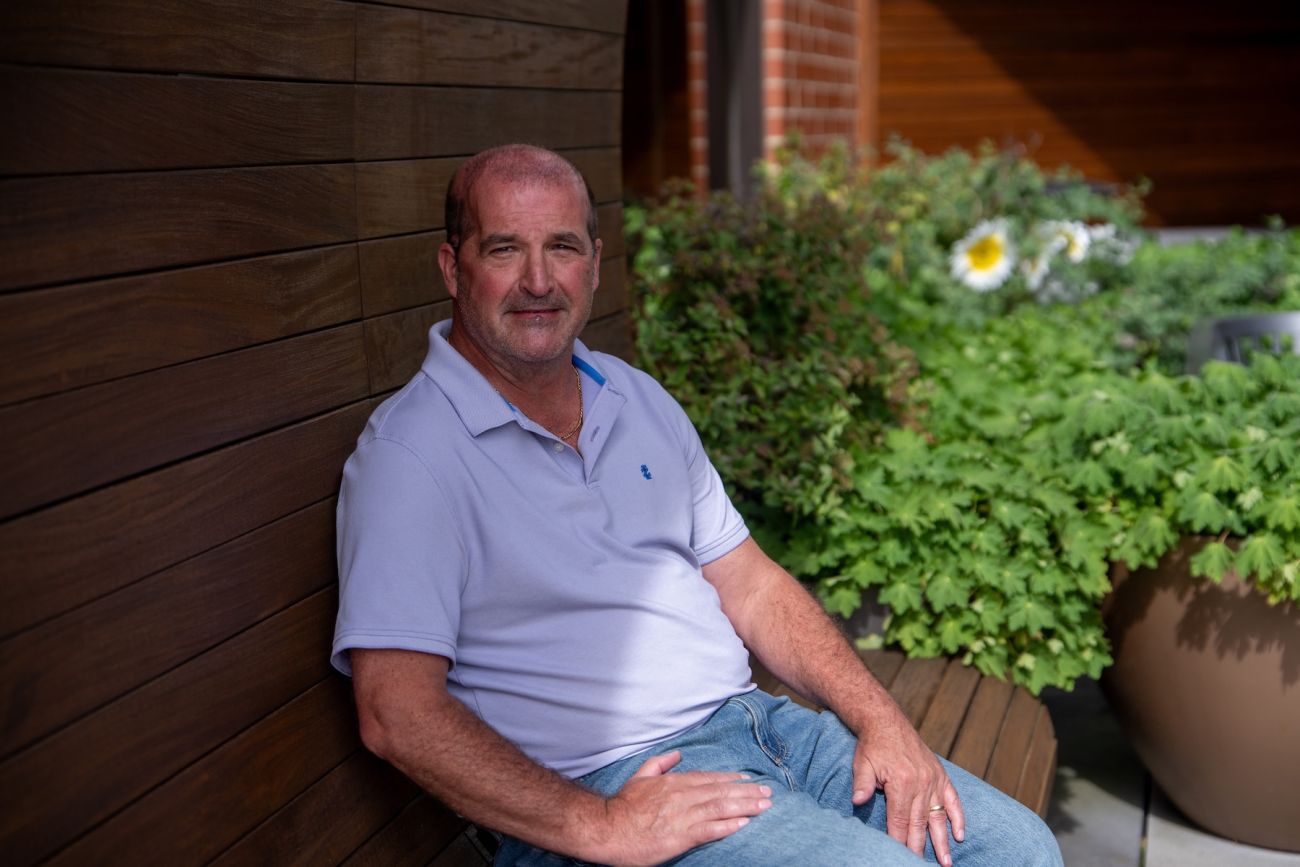
Maybe you’ve heard the phrase “when one door closes, another door opens.” For Gary McLouth, the door to his future felt like it was slamming shut in late 2024. At age 57, he was diagnosed with glioblastoma, a notoriously aggressive brain cancer with an average survival of only 12 to 16 months.
After a year of standard treatment, Gary’s doctor at Roswell Park Comprehensive Cancer Center offered him the chance to open a new door: expanded access to SurVaxM, a promising brain cancer immunotherapy developed at Roswell Park. Based on early results in national clinical trials, SurVaxM was fast-tracked to apply for approval by the FDA and has already extended the lives of some patients for more than three years.
“When my aunt, a retired nurse, heard that I was a candidate for SurVaxM, she said, ‘You’re either going to die of cancer or you’re going to live with cancer. You have to decide which you want it to be,” Gary says. Now, nearly two years later, Gary knows he made the right decision.
Fatigue and memory issues were warning signs
For Gary and his family, 2024 was a rough year. “My son had back surgery, my wife was diagnosed and treated for ovarian cancer at Roswell Park, and my daughter left for college. By late fall, I wasn’t feeling great either. I was exhausted every day when I got home from work and I slept more than usual. I figured it was from burning the candle at both ends, helping my family as they recovered from their health issues. One afternoon, my son asked me the score of football game I was watching, but I’d dozed off so many times during the game that I didn’t know the score or even which teams were playing.
"That’s when my wife called our doctor, who suspected I was having a stroke or some other brain-related issue and advised us to go the emergency room immediately.” Gary recalls. He had swelling of the brain, caused by a large tumor; he underwent surgery to remove as much of the tumor as possible. “When I woke up, I had one heck of a scar on my skull and my surgeon told me my next step should be to go to the experts at Roswell Park,” Gary says.
After surgery came radiation and chemotherapy
After two weeks of recovery, Gary met with Roswell Park neuro-oncologist Ajay Abad, MD. "In his patient and caring way, Dr. Abad explained that because glioblastoma cells grow quickly in the brain, by the time a person is diagnosed, surgical removal of the entire tumor is almost impossible.” In October, Gary started standard-of-care treatment for glioblastoma: seven consecutive weeks of both radiation and daily chemotherapy with a drug called temozolomide, to kill as many of the remaining cancer cells as possible. While a clinical trial of SurVaxM was running at the time, it was set to conclude before Gary would be able complete the entire course of chemotherapy and radiation required for enrollment. “My chemotherapy drug was a pill that I took at home and I only felt sick for a few hours when I first started taking this.”
Gary received his radiation treatment at Roswell Park every weekday. "The radiation team there is one well-oiled machine; they are friendly and efficient.” And, in a happy coincidence, Gary was surprised to see Victoria (Torey) Bruns, the nurse practitioner who works with Dr. Abad, as part of his treatment team. “Torey is the daughter of the CEO of the company I work for and I’ve known her since she was a kid!”
Expanded access to SurVaxM offers expanded hope
After completing radiation, Gary got a month-long break from treatment and then resumed five days of chemotherapy followed by 25 days off, for the next 11 months. “At my February 2025 appointment, Dr. Abad explained that, based on previous SurVaxM trial results, he strongly believed I would benefit from adding the drug to my treatment. Although the clinical trial for SurVaxM had closed, Gary was able to get the treatment through an expanded access protocol.
“I learned that Dr. Abad and his team had proactively applied for me to receive expanded access to SurVaxM and I was already pre-approved for the protocol if I wanted to pursue this avenue. After hearing that, the decision to try SurVaxM was easy for me,” Gary says. In other words, another door opened.
SurVaxM: Immunotherapy for glioblastoma
Find out more about this promising cancer vaccine developed at Roswell Park.
Looking toward the future
In addition to his new chemotherapy cycles, Gary received four doses of SurVaxM, given in the arm just like a flu shot, spread out over two months, followed by a booster dose and check-ups every 10 weeks. “I had no side effects at all from the shots, unless you consider still being alive a side effect,” Gary laughs.
Now, two years after his diagnosis, Gary still has much more he wants to do. “I work at a job I love. I want to celebrate more anniversaries with my wife and birthdays with my kids, friends and family. I want to see my daughter graduate from college, and watch my kids get married. I want to continue to play softball and coach and manage the soccer club I joined when my kids were young, and maybe even start scuba diving again. I want to repay the kindness and care that so many people extended to us while my wife and I went through our cancer treatments.
“I want to share my story to let others know about the excellent care and clinical breakthroughs happening at Roswell Park and to give others who are diagnosed with glioblastoma hope for the future.”
Editor’s Note: Cancer patient outcomes and experiences may vary, even for those with the same type of cancer. An individual patient’s story should not be used as a prediction of how another patient will respond to treatment. Roswell Park is transparent about the survival rates of our patients as compared to national standards, and provides this information, when available, within the cancer type sections of this website.