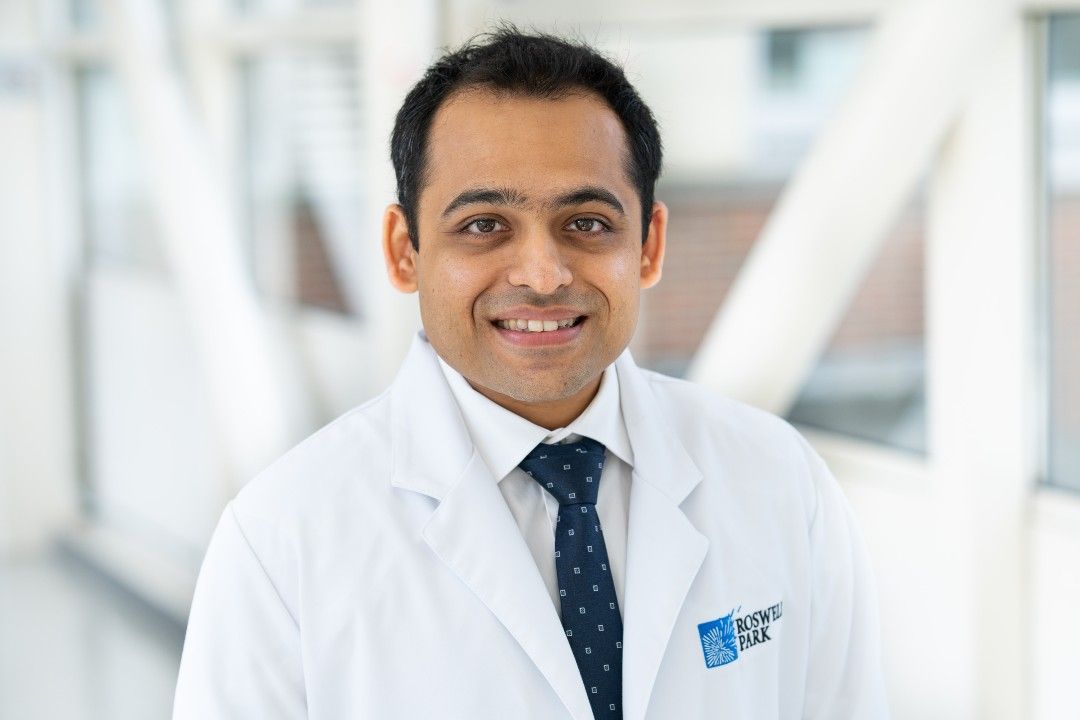
Team co-led by Roswell Park’s Dr. Prantesh Jain documents accuracy of computational biomarker the group developed
- Tool guides decision-making to avoid unnecessary treatments
- Results also predict overall survival
- Requires no additional biopsies or procedures
BUFFALO, N.Y. — Results of a new study conclude that a pathology tool powered by artificial intelligence can predict whether a patient with extensive-stage small cell lung cancer will respond to platinum-based chemotherapy — before treatment has begun, and without additional biopsies. That means patients can avoid treatments that are unlikely to help them, have a chance to enroll earlier in clinical trials of newer drugs and may get a clearer picture of their prognosis.
The accuracy of the tool, called PhenopyCell, has been verified by the three institutions that collaborated on the study, published in the journal npc Precision Oncology. PhenopyCell was developed by a research team co-led by thoracic oncologist Prantesh Jain, MD, FACP, of Roswell Park Comprehensive Center and Anant Madabhushi, PhD, of Winship Cancer Institute of Emory University in Atlanta.
The team’s findings offer a ray of hope for the 70% of patients with small cell lung cancer (SCLC) who have extensive-stage disease when they are first diagnosed. At that point, the disease has spread to other parts of the body and is rapidly progressing, with most patients surviving only 12 to 13 months, so it’s critically important to quickly identify the best potential treatment.
While there are different subtypes of SCLC, currently there is no way to distinguish one from another, so all patients receive the standard treatment of platinum-based chemotherapy plus immunotherapy. By the time the disease progresses, showing that the treatment isn’t working, often it is too late to start a different treatment. New SCLC treatments have recently been approved by the FDA or are showing promise in clinical trials, but they work in only a small number of patients. With many other types of cancer, biomarkers — biological “flags” such as proteins or genetic mutations found in blood and tissue — can indicate how patients will respond to particular treatments. But no biomarkers have been identified for SCLC.
“We are entering an era where we will have more tools than ever to offer people with small cell lung cancer,” says Dr. Jain. “But knowing which tool is right for which patient requires biological markers, and right now we don’t have them.” PhenopyCell, the new computational biomarker, helps fill that gap by combining data from different sources, such as pathology slides and patients’ medical records, and figuring out how the data correspond to patient outcomes.
For their retrospective study, the team used PhenopyCell to analyze the standard pathology slides of 281 patients with SCLC who were treated at Roswell Park, Winship and University Hospitals Cleveland Medical Center. Based on information about the immune cells seen in the tissue samples from the diagnostic biopsy, the tool predicted patients’ response to platinum-based chemotherapy before treatment began. Investigators compared those predictions with the patients’ actual outcomes — and found that the computational biomarker achieved greater accuracy than manual analysis.
PhenopyCell revealed that tumors of patients who had better outcomes contained more immune cells, which appeared in organized groups surrounding tumor clusters, indicating a better immune response. Patients with poor outcomes had tumors with fewer immune cells, which appeared in disorganized groups farther away from the tumor. The immune cell arrangements were visible only with the use of the artificial-intelligence-based pathology tool.
“Every patient with small cell lung cancer already has a pathology slide from their diagnostic biopsy,” notes Dr. Jain. “This system works from that existing slide. There’s no need for additional procedures or tissue collection, and no added cost. In a disease where survival is measured in months and re-biopsy is rarely possible this, has the potential to become a uniquely powerful tool.”
The team also included researchers from University Hospitals Cleveland Medical Center/Case Western Reserve University, City of Hope and Penn State Cancer Institute.
###
From the world’s first chemotherapy research to the PSA prostate cancer biomarker, Roswell Park Comprehensive Cancer Center generates innovations that shape how cancer is detected, treated and prevented worldwide. The Roswell Park team of 4,000+ makes compassionate, patient-centered cancer care and services accessible across New York State and beyond. Rated “Exceptional” by the National Cancer Institute, Roswell Park, founded in 1898, was one of the first NCI-designated comprehensive cancer centers in the country and remains the only one in Upstate New York. To learn more about Roswell Park Comprehensive Cancer Center and the Roswell Park Care Network, visit www.roswellpark.org, call 1-800-ROSWELL (1-800-767-9355) or email ASKRoswell@RoswellPark.org.
Jane Rose, Media Relations Specialist
716-845-4919; jane.rose@roswellpark.org