6-year Roswell Park study shows shorter, lower-dose approach works just as well as longer course of treatment
- Number of treatment sessions can be reduced from three to one
- Findings show lower dosage does not affect patient outcomes
- Shorter treatment schedule means less disruption to patients’ lives
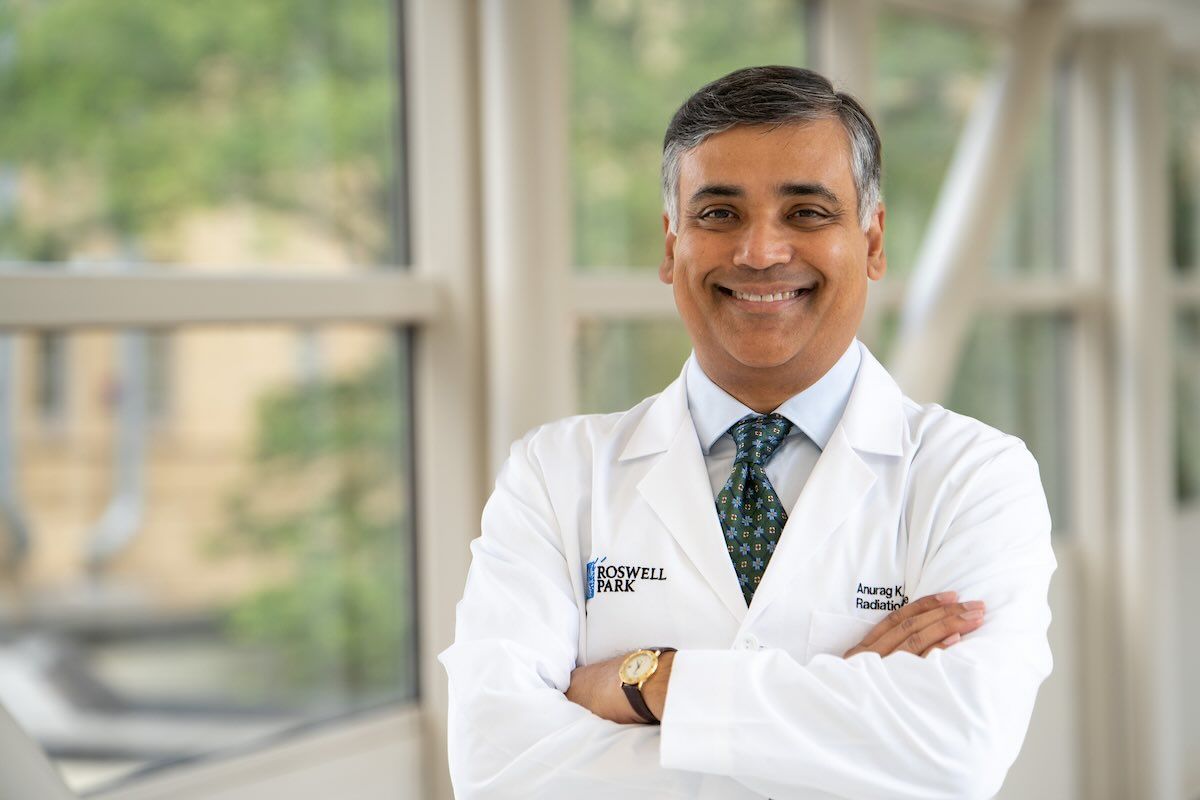
BUFFALO, N.Y. — Many people with lung cancer can be treated with a highly precise, high dose of radiation given in just one session — without compromising the effectiveness of the treatment. That’s the striking conclusion of a new study led by Anurag Singh, MD, of Roswell Park Comprehensive Cancer Center that has the potential to change the treatment recommendations for many patients with a common form of lung cancer.
The new treatment strategy, outlined in a new publication in the International Journal of Radiation Oncology, Biology, Physics, could offer multiple benefits for many patients who cannot undergo lung cancer surgery — fewer side effects from radiation exposure, less disruption to their lives and, possibly, lower medical costs.
Lung cancer is the leading cause of cancer death in the United States, and a type known as non-small cell lung cancer (NSCLC) accounts for about 85% of those cases. When patients with early-stage lung cancer cannot undergo surgery because of their age, condition or other reasons, typically they are treated with stereotactic body radiation therapy (SBRT), a form of medical radiation that precisely targets tumors to avoid damaging healthy tissues nearby.
One session instead of three — but just as effective
Looking at how well patients responded to treatment over a six-year period, Dr. Singh and his colleagues from Roswell Park, the Cleveland Clinic’s Taussig Center and the State University of New York Upstate Medical Center in Syracuse show that reducing both the radiation dose and the number of treatment sessions results in the same long-term results as a higher dose delivered over more treatment sessions. They found that one session at half the usual radiation dose works just as well as three higher‑dose sessions. That means:
- No difference in how long patients live
- No increase in cancer growth or spread
- No increase in radiation-related side effects
- Much less time spent traveling to and from appointments
“Single-fraction stereotactic body radiation therapy to peripheral lung tumors is cheaper, more convenient and just as effective,” says Dr. Singh.
What the study found
The clinical trial followed 98 patients with early-stage NSCLC whose tumors were located in the outer parts of the lung and who were not able to undergo surgery. Participants were randomly assigned to one of two approaches:
3 fraction SBRT: 60 gray (Gy, or units) of radiation, delivered over three sessions
One Fraction SBRT: 30 Gy delivered in one session
Patients were monitored regularly for up to five years. The research team found no meaningful differences between the two groups in survival, cancer recurrence or side effects.
“This is an easy way to lower costs and increase convenience for patients without compromising on cancer control,” says Dr. Singh. “This approach may be even more important to those patients who must travel large distances to receive radiation.”
###
From the world’s first chemotherapy research to the PSA prostate cancer biomarker, Roswell Park Comprehensive Cancer Center generates innovations that shape how cancer is detected, treated and prevented worldwide. The Roswell Park team of 4,000+ makes compassionate, patient-centered cancer care and services accessible across New York State and beyond. Rated “Exceptional” by the National Cancer Institute, Roswell Park, founded in 1898, was one of the first NCI-designated comprehensive cancer centers in the country and remains the only one in Upstate New York. To learn more about Roswell Park Comprehensive Cancer Center and the Roswell Park Care Network, visit www.roswellpark.org, call 1-800-ROSWELL (1-800-767-9355) or email ASKRoswell@RoswellPark.org.
Jane Rose, Media Relations Specialist
716-845-4919; jane.rose@roswellpark.org