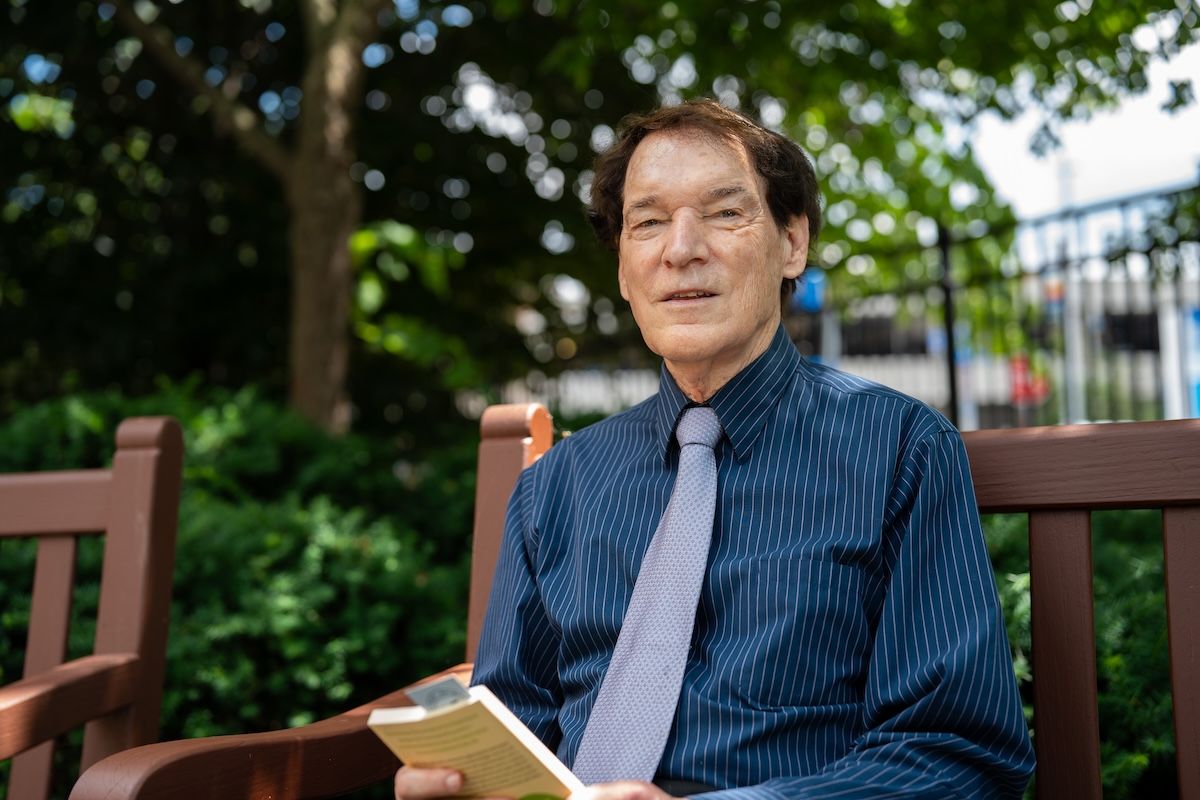
"There's a light at the end of the tunnel, and it's Roswell."
- Combining radiotherapy advances for prostate cancer recurrence
- Getting a second opinion can change treatment plan, outlook
- New technology offers radiation treatment in five sessions
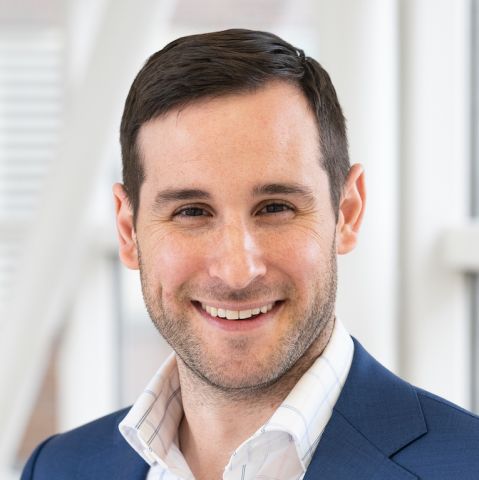
It’s high praise when an esteemed scientist-physician is anxious to champion Roswell Park Comprehensive Cancer Center because of the prostate cancer treatment he received.
“Roswell’s been great and I would like to see that message transferred out to other people, just about cancer in general,“ Dr. Robert Welliver says about the team who steered him through an advanced form of radiotherapy — a combination of adaptive radiation therapy (ART) and stereotactic body radiation therapy (SBRT) — to treat prostate cancer that had recurred.
“The prevailing attitude there is ‘yeah, we’re taking you seriously but there’s room to be humorous and to be human.’ I was very, very impressed with that. They were knowledgeable. They were fun, happy people even though they’re dealing with something serious. It was just very, very comfortable.”
Knowing Roswell Park offers such innovation for prostate cancer treatment is incredibly invaluable, he adds: “If you don’t know, you’re going to be as frightened as I was and I’m a physician. Cancer in that part of your body and radiation in that part of your body is a little scarier than if it’s in your elbow or someplace like that.”
Cancer recurrence brought him to Roswell Park
A longtime Buffalo resident and administrative emeritus of Golisano Children’s Hospital of Buffalo, Robert had been monitoring and managing his PSA levels for years and was living in Oklahoma City, leading a pediatric infectious disease research project, when he was first diagnosed with prostate cancer. “I discovered that my PSA was climbing and that something needed to be done,” he says.
In 2021, he connected with an Oklahoma City urologist he describes as a “terrific physician” (and who has since become his good friend), who advised him to undergo surgery first. “He said you can always go back to radiation if surgery doesn’t remove all the cancer. He did a six-hour operation,” Robert explains, adding that following the surgery that removed his prostate, he was advised that his scans showed no signs of cancer. “He was meticulous, he wanted to get everything.”
By January of 2022, “reluctantly retired” and back in Buffalo where he still has family, Robert discovered his PSA levels creeping up again. An appointment with the hometown urologist who was following his prostate health led to a scan. “It found I had a 5-millimeter (mm) recurrence at the base of the prostate bed, where the prostate was, before removal,” Robert recalls.
The urologist referred him to a radiation oncologist in the shared practice, who told him his prostate cancer was, likely, now too advanced to benefit from the radiation treatment he could provide — and referred Robert to another radiation oncologist in Rochester.
“I decided Rochester is kind of far to go to get involved in radiation therapy, so I’ll go to Roswell Park,” Robert says. “From the first minute I was inside the building there it’s just been great. It’s been extremely positive.”
The innovation of combining radiation therapy advances
Robert was referred to radiation oncologist Mark Farrugia, MD, PhD, for ART/SBRT treatment, which combines two critical advances in radiation therapy:
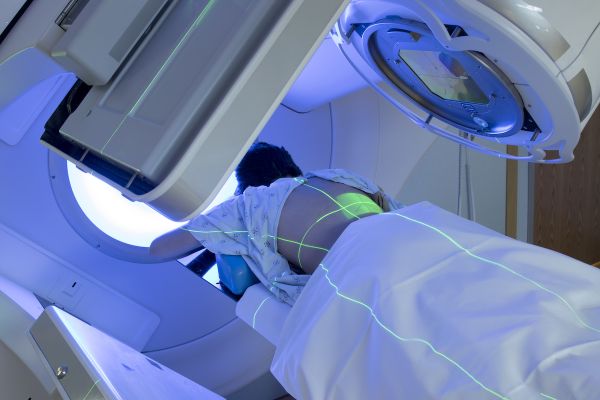
Adaptive radiation therapy (ART) is a new technology that adapts the treatment plan in real time to account for natural daily shifts in a patient’s anatomy due to factors like bladder size or tumor shrinkage. Daily imaging before each treatment scans the targeted area to reveal the precise real-time position of the tumor and surrounding healthy organs. Then, using artificial intelligence software, oncology teams can quickly and efficiently adjust the target areas and safety margins that ensure daily radiation plans fit the patient on that treatment day.
Stereotactic body radiation therapy (SBRT) integrates 3D imaging and custom immobilization devices to deliver high doses of radiation to the tumor with pinpoint accuracy. This precision means we are able to treat in fewer sessions, without increasing side effects. Combining these technologies provides a way to deliver intense, high-dose radiation in just one to five sessions (compared to the 30 to 40 radiation sessions required for conventional radiation), while ensuring the radiation continuously targets the tumor and spares surrounding healthy tissue.
ART/SBRT also offers a noninvasive alternative to surgery that minimizes complications and potential side effects. The convenience of fewer hospital visits and elimination of a surgical recovery period means patients can often return to their normal routines almost immediately. Adaptive radiation was made possible thanks to donations to the Roswell Park Alliance Foundation.
“It was five sessions, every other day for 10 days, five actual days that you get radiation,” Robert explains. “Each session was 10 to 15 minutes of calibrating the radiation field, and then five to ten minutes of radiation. Each session took about a half hour.”
It matters where you go for your prostate cancer treatment
If radiation therapy is part of your prostate cancer treatment plan, choosing where to receive your treatments is one of the most important decisions you’ll make. Roswell Park uses the latest technologies and techniques that allow us to deliver your radiation therapy for prostate cancer in just five days and simultaneously reduce risk for side effects.
Choosing Roswell Park for better prostate treatment, survival
“As soon as I met Dr. Farrugia I liked him. I thought, this guy is great and it’s going to be OK. He’s a bright, happy guy, positive in every way, answers all your questions and understands what you’re thinking. He said, ‘We will focus in, really, really focus in on that area. Hitting it hard in a small area, you don’t really get the complications you might think,’” Robert says.
“What I liked especially was that he said, ‘If you get another recurrence we’ll take care of it, but this isn’t going to kill you in the long run.’ That’s really what I wanted to hear, because I’ve seen guys who were fading away from prostate cancer and I didn’t like how it looked at all.” After his first meeting with Dr. Farrugia, Robert felt “way more” confident about the prognosis he envisioned when he first learned about the recurrence of his prostate cancer. It’s been a little more than a month now since he completed the treatment in May; ART/SBRT recovery is typically one to three months.
“I feel fine. I feel great,” he says. “I have the same energy I had before this.”
Getting a second opinion changed his treatment plan and outlook
When Robert first heard about ART/SBRT, he learned the technology can help people survive prostate cancer for at least 15 years after treatment. “Even if your PSA number is 70, which is what mine was, and you think this is really bad, and my Gleason score was 8 and the highest you can get is 10, people should know this — with the tag on that this can be curative,” he says, stressing the critical importance of consistent PSA monitoring. “There’s a reason to get tested.“
Robert also wants people to actively pursue a second opinion if they feel uncomfortable with a diagnosis and treatment recommendation. His own arrival at Roswell Park was driven largely by a diagnostic recommendation that he knew, as a well-tenured physician, was inaccurate.
“Get a second opinion if you need to, and a really good place to get that information is Roswell,” he advises. “I mean that from the bottom of my heart because it drastically and dramatically changed my outlook and attitude toward this and everything that’s happened.”
Right now, he says, “life is good,” in part because of his experience with Roswell Park. “I’m very happy. I’m sorry that I’m not still seeing patients, but other than that I go out and run, I lift weights, I take my kids to baseball games and there’s a lot to live for.”
The esteemed Robert Welliver Sr., MD, has five children: three sons are also physicians – in urology, pediatric ER practice and cancer research. The fourth son is in commercial banking, and his daughter is pursuing a degree in psychology. He also has five grandchildren.
“There’s a shining light at the end of the tunnel, and it’s Roswell,” he says.
Cruisin' for a Cure 2026
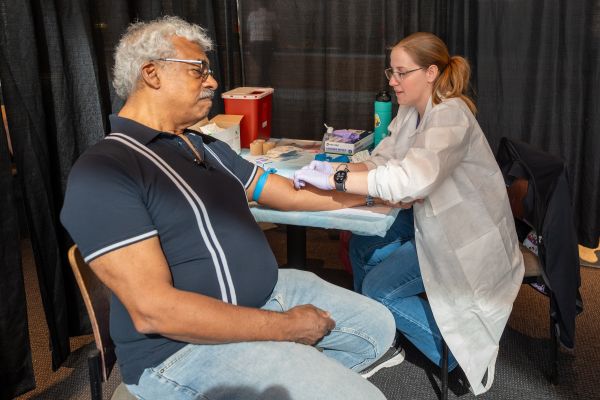
The car show that saves lives! Join us for a prostate cancer education and screening clinic at Cruisin' for a Cure, Saturday, September 26, 2026.
Editor’s Note: Cancer patient outcomes and experiences may vary, even for those with the same type of cancer. An individual patient’s story should not be used as a prediction of how another patient will respond to treatment. Roswell Park is transparent about the survival rates of our patients as compared to national standards, and provides this information, when available, within the cancer type sections of this website.