It sounds like a medical treatment from a science fiction novel: Instead of opening a patient’s skull to remove a brain tumor or correct an abnormality, physicians obliterate the target from outside the body using 200 precisely aimed gamma ray beams, protecting healthy brain tissue from unintended damage. It’s a welcome option for patients with tumors in hard-to-reach areas of the brain. It doesn’t require an overnight hospital stay, there’s no blood loss, and the most common side effects are minor — fatigue, headache and scalp irritation.
Since Roswell Park first began offering Gamma Knife radiosurgery 27 years ago, the cancer center has emerged as a world leader in the procedure. Today Roswell Park has the busiest single Gamma Knife program in the U.S. and most of the world, operating every day of the week, treating more than 900 patients every year and pioneering new treatment strategies.
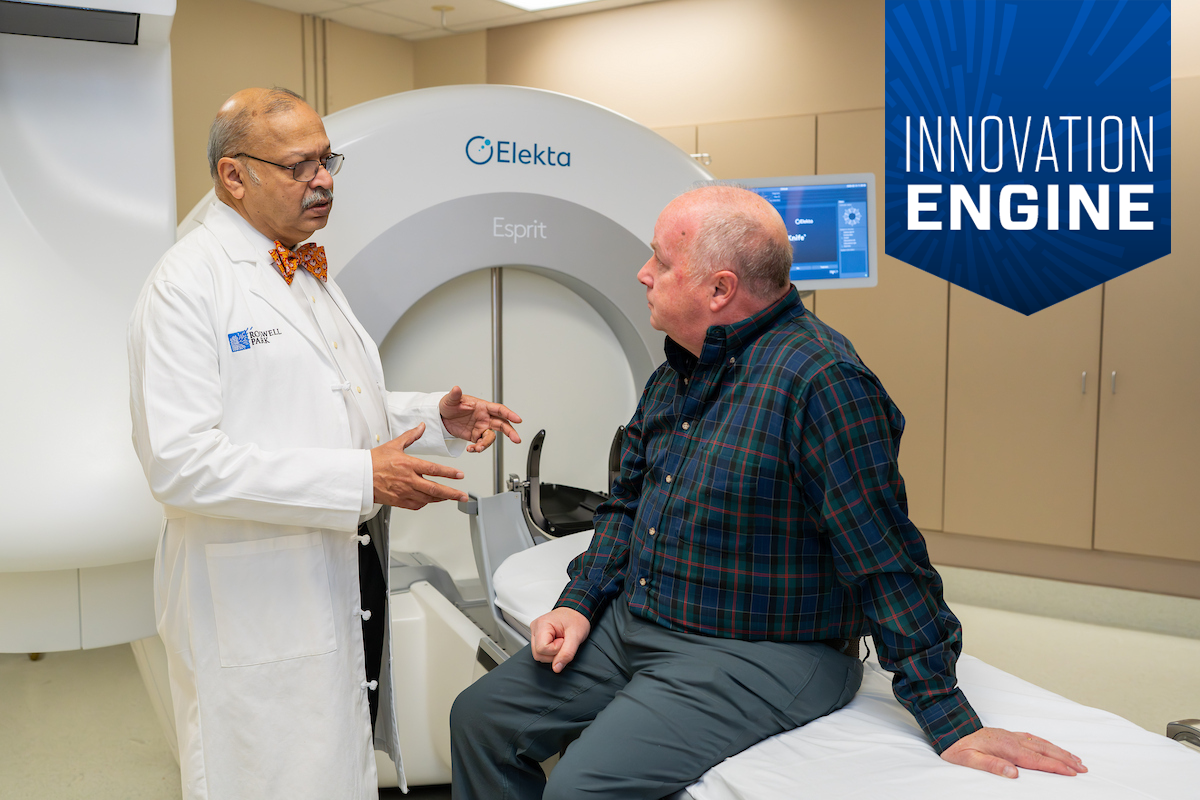
Dheerendra Prasad, MD, MCh, FACRO, incoming Chair of Radiation Medicine and Chief of Gamma Knife Radiosurgery, took the leadership of the Roswell Park program in 2005, leveraging his experience of having treated more than 18,000 patients over the course of his career. He has mentored more than 80 Gamma Knife teams around the globe, including every single one in Canada, Australia and India, and his expertise is sought by many leading cancer centers in the U.S. Thanks to his stature in the field, Roswell Park is first to acquire the latest machine updates and offer the newest techniques.
Data collected from Gamma Knife treatments at Roswell Park are shared with the International Leksell Gamma Knife Society and the International Stereotactic Radiosurgery Society members as well as the manufacturer, to help perfect the machine’s design, expand its capabilities, make the procedure more comfortable and effective, and support changes in clinical guidelines that make it accessible to more patients. Members of the Roswell Park team regularly present their findings at international conferences, sharing their strategies for achieving the best treatment outcomes.
“Saving brains by changing minds”
When Dr. Prasad first arrived at Roswell Park, the National Comprehensive Cancer Network (NCCN), which publishes the most widely used recommendations for cancer treatment, advised physicians to limit the number of tumors treated by Gamma Knife radiosurgery — bad news for those who had more than four tumors or developed new tumors. Once a patient reached the limit, the NCCN recommended switching to whole-brain radiation or other options — but those treatments carried a higher risk of impairing the patient’s thinking and memory.
“We have changed that,” Dr. Prasad says proudly. “Data coming from Roswell Park and other Gamma Knife centers have demonstrated that those limits were unfounded, and the new guidelines reflect that. Changing the guidelines means health insurance is now more likely to cover the procedure, so more patients will be able to access it.
“As a result, we can offer Gamma Knife for patients with tumors that have metastasized to the brain from other parts of the body, using pinpointed techniques that prevent their brains from being damaged by unnecessary radiation. That means they can retain their brain function and memory much longer. That’s a big part of what our program has contributed to the world stage — we’re saving brains by changing minds.”
New milestones achieved
Under his leadership, the Gamma Knife team has achieved new milestones, including:
- Pioneering a way to treat patients with glioblastoma, the most deadly type of brain tumor, using Gamma Knife radiosurgery along with SurVaxM, a promising brain cancer immunotherapy developed at Roswell Park.
- Demonstrating Gamma Knife offers a nonsurgical option for recurrent glioblastoma. Their published studies showed that patients with glioblastoma don’t always need additional surgery when their brain tumors return. “They can be treated with selective focal Gamma Knife radiosurgery, which helps extend the length and quality of the patient’s life without another operation,” explains Dr. Prasad.
- Becoming leaders in using “contrast clearance analysis,” an imaging technique that helps to discern tissue damaged by radiation from the growth of a new tumor, making it possible to treat new tumors earlier, when they’re more likely to respond to therapy.
- Employing a new type of imaging called a Prostate-Specific Membrane Antigen (PSMA) PET scan, which zeroes in on tumors that have spread to the brain from the prostate, allowing more precise treatment for those patients.
Caring for the youngest patients
Roswell Park is the only center in Western New York equipped to offer Gamma Knife treatments for children, whose smaller size requires both different equipment and general anesthesia. To keep the patient’s head in place during treatment, adults are fitted with an aluminum “halo” surrounding the skull, held in place with lightweight pins. Children, whose skulls are more fragile, receive a soft, custom-fitted mask — and because they’re more likely than adults to move around, they also need general anesthesia, which must be provided by a pediatric anesthesiologist.
“We’re making this treatment much more patient friendly,” explains Dr. Prasad. “We’re fully equipped to look after young patients, and that speaks to our close relationship with Golisano Children’s Hospital through the Roswell Park Golisano Children’s Buffalo Cancer and Blood Disorders Program.”
The Roswell Park Advantage
Dr. Prasad, Director of the Gamma Knife Center, has treated more than 18,000 patients with Gamma Knife radiosurgery and serves as an onsite advisor and mentor to more than 80 institutions worldwide.
Safety and versatility
With a multidisciplinary team of 25 experts — including 10 board-certified neurosurgeons with Gamma Knife training and experience, radiation oncologists and medical physicists — Roswell Park’s Gamma Knife team treats both cancer and non-cancerous conditions, including benign brain tumors, trigeminal neuralgia, essential tremor and other movement disorders, as well as tangled blood vessels called arteriovenous malformations.
Even though Gamma Knife radiosurgery treats tumors in the highly delicate area of the nervous system, the procedure is very safe, notes Dr. Prasad. “We have excellent outcomes, and complications from the treatment are as close to zero as it can get. It’s also highly effective, with tumor-control rates ranging from 80 to 95%.” Initial consultations take place within three days for patients with malignant tumors and seven days for benign tumors, with treatment typically beginning in 10 days or fewer.
He and his team analyze their data continuously, always focused on what they can do better. “We update our results all the time,” says Dr. Prasad. “Because we are called upon to treat so many patients, we have learned to use the latest tools very efficiently, allowing for other treatments to continue without interruptions. Our patients are the main story, and we’re helping them every day.”