Roswell Park-led preclinical study reports promising new target for treating B-cell leukemia, lymphoma
- CD83 CAR T may offer greater efficacy when administered after CD19 CAR T
- Added benefit seen in low risk of life-threatening B-cell aplasia
- Study appears in Journal for ImmunoTherapy of Cancer
BUFFALO, N.Y. — CAR T-cell therapy targeting the cell-surface protein CD19 is the standard of care for aggressive B-cell malignancies that have relapsed or are treatment-resistant, and in some cases, it can result in a cure. But if the disease relapses after CD19 CAR T therapy, median overall survival is poor. Writing in the Journal for ImmunoTherapy of Cancer, a team from Roswell Park Comprehensive Cancer Center suggests a way to change that outcome.
In the new preclinical study, the team reports that CAR T therapy — short for chimeric antigen receptor (CAR) T-cell therapy, an advanced form of cancer immunotherapy that reprograms a patient’s own immune cells to find and destroy cancer cells — that is designed to target a different protein, CD83, can renew the immune system’s attack against cancer cells when CD19 antigen loss reduces the effectiveness of CD19 CAR T.
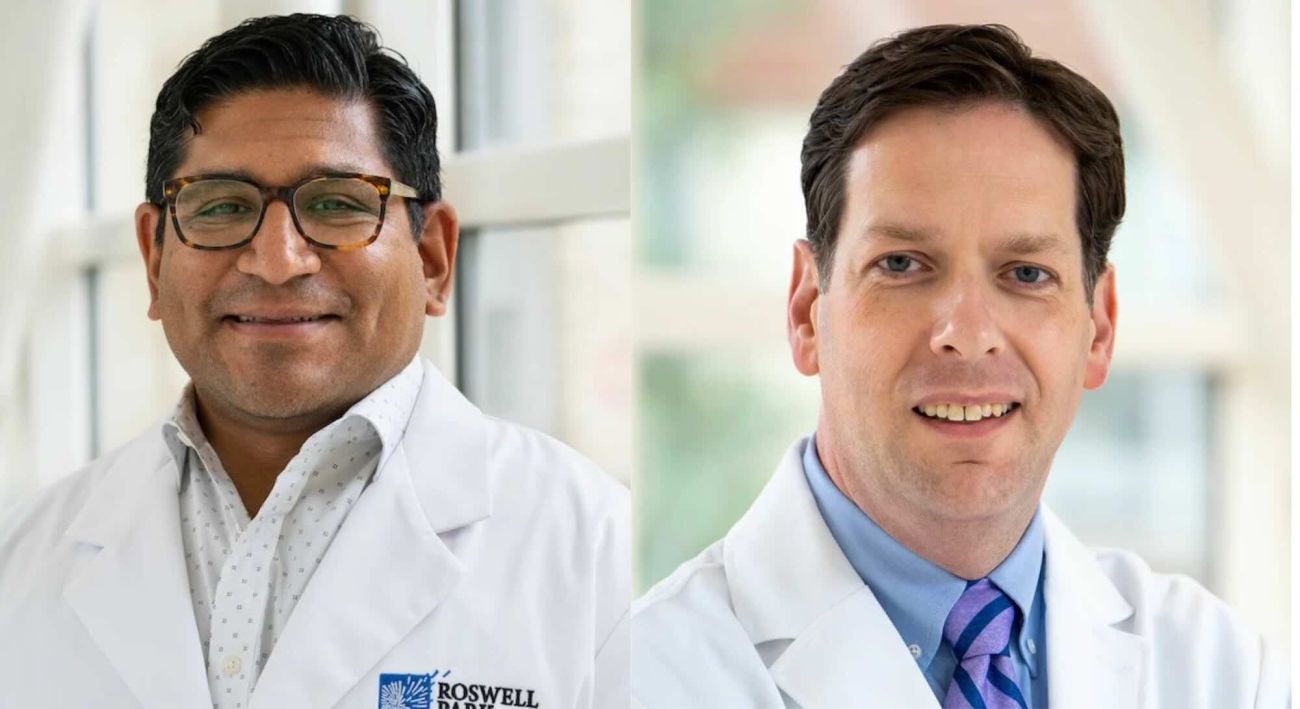
The work was led by first author Brian Betts, MD, Vice Chair of Strategic Initiatives in Cell Therapy at Roswell Park, and senior author Marco Davila, MD, PhD, Senior Vice President and Associate Director for Translational Research at Roswell Park and a pioneer in the field of CAR T-cell therapy. Using both in vitro and in vivo preclinical models, the team evaluated CD83 expression in several B-cell malignancies, which affect the white blood cells that produce antibodies and help fight infection. They found that it is expressed in acute lymphoblastic leukemia (ALL), mantle cell lymphoma (MCL) and diffuse large B-cell lymphoma (DLBCL), but not in chronic lymphocytic leukemia (CLL) or circulating healthy B cells.
Comparing the potency of both CD19 and CD83 CAR T cells, the researchers discovered that after B-cell ALL is treated with CD19 CAR T-cell therapy, loss of the CD19 antigen can make the treatment ineffective.
“Even in cases where prior cell therapy has taken CD19 out of the equation, CD83 is still expressed and can serve as an alternate target,” says Dr. Betts. “That provides two routes for eradicating the cancer cells.”
The team reports that CD83 CAR T was also effective when administered as a monotherapy in preclinical models. The researchers also found another benefit of CD83 CAR T therapy: B-cell aplasia, which leaves patients with an insufficient number of infection-fighting B lymphocytes, is a major cause of non-relapse-related death after CD19 CAR T, but CD83 CAR T is associated with a low risk of aplasia.
CD83 CAR T-cell therapy is now being evaluated in a phase 1 clinical trial (NCT06871410) offered exclusively at Roswell Park for patients with acute myeloid leukemia (AML) that has relapsed or is treatment-resistant. Investigators hope results of the trial will provide safety data to inform future clinical trials of CD83 CAR T for B-cell malignancies.
“CAR T-cell therapy has revolutionized the treatment of blood cancers that have relapsed or are treatment-resistant, often leading to long-lasting remissions in patients who have limited options,” notes Dr. Davila. “CD83 offers a promising new target that could extend the benefits of CAR T to an even greater number of people.”
The research team included additional co-authors from Roswell Park as well as collaborators from Moffitt Cancer Center and the University of Minnesota Twin Cities.
This study was supported by the National Institutes of Health under award number R01HL167232 and the National Heart, Lung and Blood Institute. Early philanthropic investment from the 11 Day Power Play Team Science Grant and the Roswell Park Alliance Foundation helped lay the foundation for the CD83 clinical trial, advancing promising research toward new possibilities for patients.
###
From the world’s first chemotherapy research to the PSA prostate cancer biomarker, Roswell Park Comprehensive Cancer Center generates innovations that shape how cancer is detected, treated and prevented worldwide. The Roswell Park team of 4,000+ makes compassionate, patient-centered cancer care and services accessible across New York State and beyond. Rated “Exceptional” by the National Cancer Institute, Roswell Park, founded in 1898, was one of the first NCI-designated comprehensive cancer centers in the country and remains the only one in Upstate New York. To learn more about Roswell Park Comprehensive Cancer Center and the Roswell Park Care Network, visit www.roswellpark.org, call 1-800-ROSWELL (1-800-767-9355) or email ASKRoswell@RoswellPark.org.
Jane Rose, Media Relations Specialist
716-845-4919; annie.deck-miller@roswellpark.org