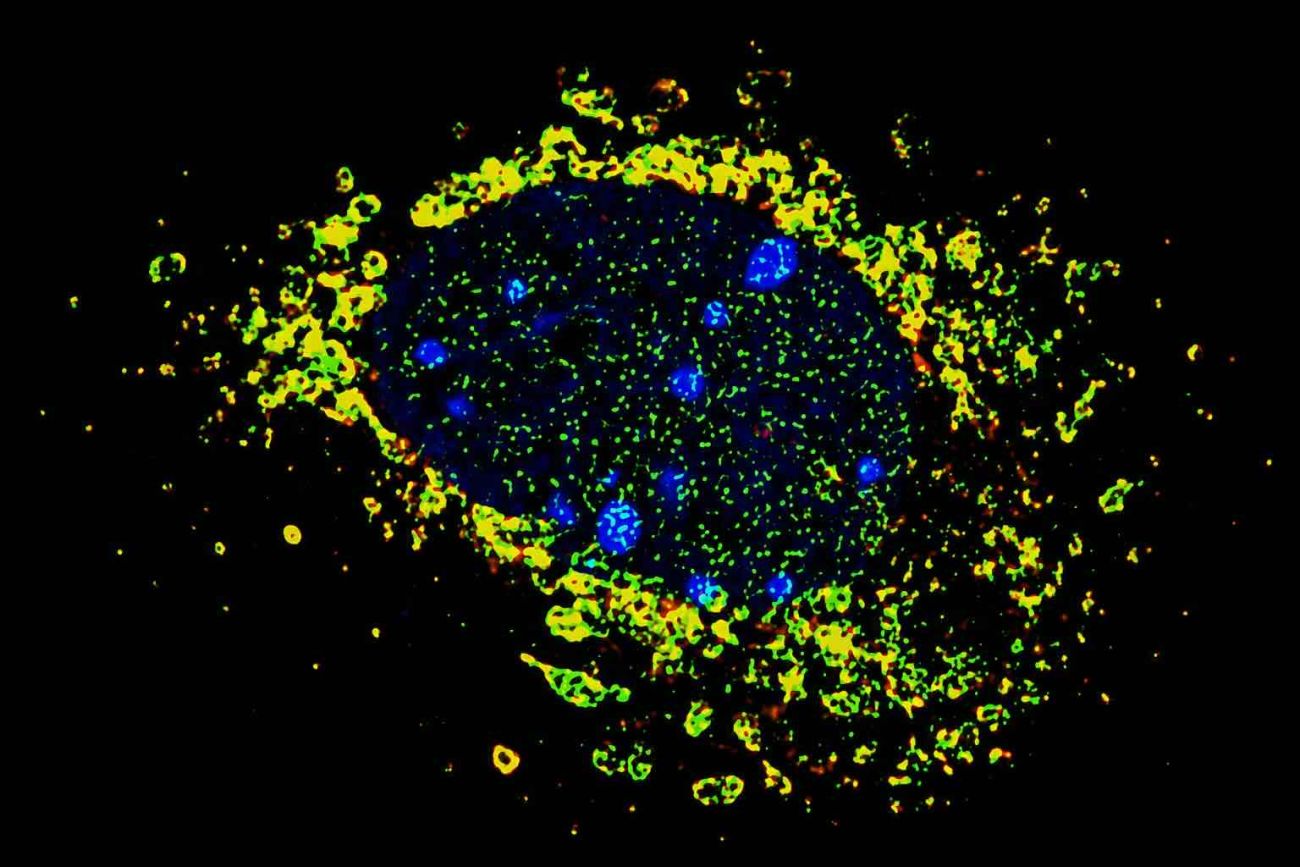
Dr. Subhamoy Dasgupta and team show that blocking this pathway severely restricts tumor proliferation
- Metabolic enzymes in the nucleus control gene activation
- Findings could inform new ways of overcoming treatment resistance
- Preclinical study published in Nature Communications
BUFFALO, N.Y. — A team at Roswell Park Comprehensive Cancer Center has identified a novel metabolic pathway that plays a key role in enabling cancer to progress through gene activation. In a new study in the journal Nature Communications, the researchers show that shutting down the pathway can seriously impair the ability of tumor cells to multiply and spread.
“Our work establishes a critical link between metabolism and epigenetic regulation in cancer,” says study senior author Subhamoy Dasgupta, PhD, Co-Leader of the Cancer Stress Biology Program at Roswell Park.

When enzymes that are typically found in the mitochondria, the “powerhouse of the cell,” travel to the nucleus, a nuclear metabolic pathway can help them acquire the ability to interact with DNA and consequently to control gene activation by flipping genes “on” or “off” to help a tumor grow. Dr. Dasgupta and colleagues found that under stress, two mitochondrial enzymes — aconitase (ACO2) and isocitrate dehydrogenase (IDH2) — move to the nucleus and produce a metabolite called acetyl CoA. This metabolite then alters the histone proteins around which DNA is wrapped, making it possible to unwind the DNA to provide needed access for gene activation.
However, the researchers found that blocking this nuclear metabolic pathway caused the chromatin to close tightly around the DNA, restricting access and severely impairing the ability of the mitochondrial enzymes to control gene expression or activate the gene MKI67, which helps tumor cells multiply.
The findings help explain the link between mitochondria, which generate energy for cells and are vital for tumor growth, and the nucleus of the cell, which activates genes by integrating cellular and environmental signals. Until now it was not known what role cellular metabolism played in gene activation, which takes place in the nucleus.
“Based on our discovery, we are now working to further investigate the therapeutic potential of targeting this unique nuclear-metabolic pathway in several types of cancer that are known to develop resistance to therapies and metastasize to vital organs,” notes Dr. Dasgupta. “We hope that this work may pave the way for better treatments for notoriously hard-to-treat cancers.”
Abhisha Sawant Dessai, PhD, who contributed to this work as a graduate student in Dr. Dasgupta’s lab and is now at the University of Pennsylvania, is first author of the study. This work was supported by grants from the National Cancer Institute (grant numbers DP2CA260421, R01CA252092, R01CA285707, U2CA232979, U24CA274159, R50CA283805 and T32CA085183) and Roswell Park Alliance Foundation. The work also relied on shared resources made possible through NCI project number P30CA016056, Roswell Park’s Cancer Center Support Grant.
###
From the world’s first chemotherapy research to the PSA prostate cancer biomarker, Roswell Park Comprehensive Cancer Center generates innovations that shape how cancer is detected, treated and prevented worldwide. The Roswell Park team of 4,000+ makes compassionate, patient-centered cancer care and services accessible across New York State and beyond. Rated “Exceptional” by the National Cancer Institute, Roswell Park, founded in 1898, was one of the first NCI-designated comprehensive cancer centers in the country and remains the only one in Upstate New York. To learn more about Roswell Park Comprehensive Cancer Center and the Roswell Park Care Network, visit www.roswellpark.org, call 1-800-ROSWELL (1-800-767-9355) or email ASKRoswell@RoswellPark.org.
Jane Rose, Media Relations Specialist
716-845-4919; jane.rose@roswellpark.org