Team shows BCL-2 promotes treatment resistance, uncovering strategy for making tumors respond to treatment
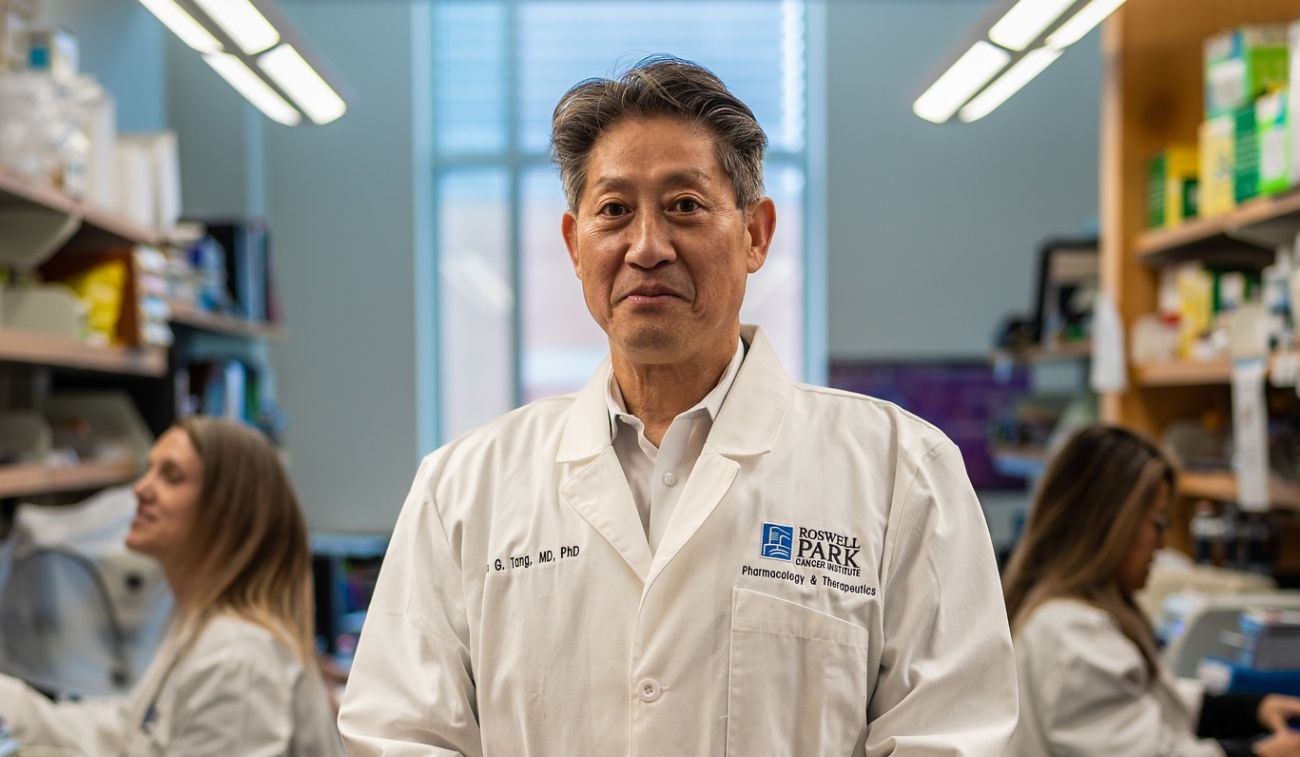
- Work led by Dean Tang, Chair of Pharmacology and Therapeutics
- BCL-2 protein is present in diverse types of treatment-resistant prostate cancer
- Study supports combination therapy of BCL-2 inhibitor plus androgen blocker
BUFFALO, N.Y. — Researchers at Roswell Park Comprehensive Cancer Center have shown that a key regulator protein plays a critical role in the development of the most aggressive form of prostate cancer. In a new publication in the journal Signal Transduction Targeted Therapy, Dean Tang, PhD, Chair of Pharmacology & Therapeutics and the George Decker Endowed Chair of Developmental Therapeutics, and colleagues report this important discovery — pointing the way to a promising treatment strategy that uses existing drugs.
The newly reported findings resolve earlier conflicting reports about the role of BCL-2, a key regulator protein, in “castration-resistant” prostate cancer — a highly aggressive and often fatal form of the disease. In the new study, the team shows that combining the BCL-2 inhibitor venetoclax (brand name Venclexta) with an androgen blocker can make these aggressive tumors more responsive to treatment.
Patients with advanced prostate cancer who cannot undergo prostatectomy — surgical removal of the prostate — are typically treated with androgen deprivation therapy (ADT), sometimes called chemical castration. ADT uses drugs called androgen receptor pathway inhibitors (ARPIs) or other types of hormone therapy to block testosterone and other male hormones that promote the growth of prostate cancer. But in most patients, the disease stops responding to treatment within two years, at which point it is generally incurable.
“Understanding prostate cancer resistance to hormone therapy and androgen receptor signaling inhibitors, the standard-of-care treatment for the disease, is crucial for developing novel combination-therapy strategies to improve long-term survival for prostate cancer patients,” says Dr. Tang.

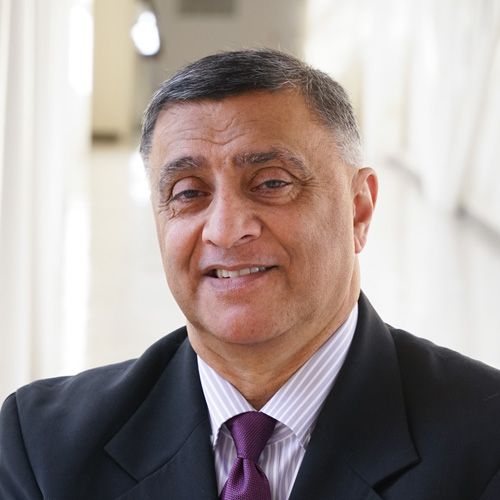
With co-corresponding author Anmbreen Jamroze, PhD, Research Assistant Professor of Oncology in Pharmacology & Therapeutics at Roswell Park, and Gurkamal Chatta, MD, Clinical Chief of Genitourinary Research, Dr. Tang initiated the current study to better understand how BCL-2 impacts castration resistance. Using multiple state-of-the-art techniques, the team analyzed data from a phase 1B clinical trial conducted at Roswell Park as well as hundreds of tissue samples.
Their work revealed for the first time the relationship of the proteins BCL-2 and androgen receptor (AR), both of which enable prostate cancer cells to survive. They found that BCL-2 is usually held in check by AR at the genomic level, but treatments with ADT and ARPIs enable BCL-2 to break free and promote the progression of castration-resistant prostate cancer. Adding the BCL-2 inhibitor venetoclax to an androgen blocker can prevent that outcome.
This analysis is the first to map changes related to AR and BCL-2 in prostate cancer cells during treatment and progression to castration-resistant prostate cancer, explains Dr. Tang. The team also found that as the tumors became castration-resistant, BCL-2 and AR exhibited a negative correlation — when one increased, the other decreased.
Their findings help explain the inconsistent results of earlier studies. “Our study provides indisputable evidence that BCL-2 is the only molecule among the five BCL-2 family members that is upregulated by ADT and ARPIs and should be therapeutically targeted across different subtypes of castration-resistant prostate cancer,” says Dr. Tang.
The team recently completed a phase 1B clinical trial led by Dr. Chatta that treated metastatic castration-resistant prostate cancer patients with a combination of the ARPI enzalutamide (brand name Xtandi) and the BCL-2 inhibitor venetoclax (brand name Venclexta). Three of the 10 patients enrolled in the trial showed clear responses after multiple cycles of the combination treatment.
Based on the study findings, the Roswell Park team plans to take the ADT/ARPI treatment combination with venetoclax to a phase 2 trial for patients with advanced and castration-resistant prostate cancer.
This project was funded in part by the National Cancer Institute (grants R01CA237027, R01CA240290, 2R01CA240290-06A1, R21CA218635 and P30CA016056), U.S. Department of Defense (PC220273), a Prostate Cancer Foundation Challenge Award and additional support from the Roswell Park Alliance Foundation and the George Decker Endowment.
###
From the world’s first chemotherapy research to the PSA prostate cancer biomarker, Roswell Park Comprehensive Cancer Center generates innovations that shape how cancer is detected, treated and prevented worldwide. The Roswell Park team of 4,000+ makes compassionate, patient-centered cancer care and services accessible across New York State and beyond. Rated “Exceptional” by the National Cancer Institute, Roswell Park, founded in 1898, was one of the first NCI-designated comprehensive cancer centers in the country and remains the only one in Upstate New York. To learn more about Roswell Park Comprehensive Cancer Center and the Roswell Park Care Network, visit www.roswellpark.org, call 1-800-ROSWELL (1-800-767-9355) or email ASKRoswell@RoswellPark.org.
Jane Rose, Media Relations Specialist
716-845-4919; jane.rose@roswellpark.org