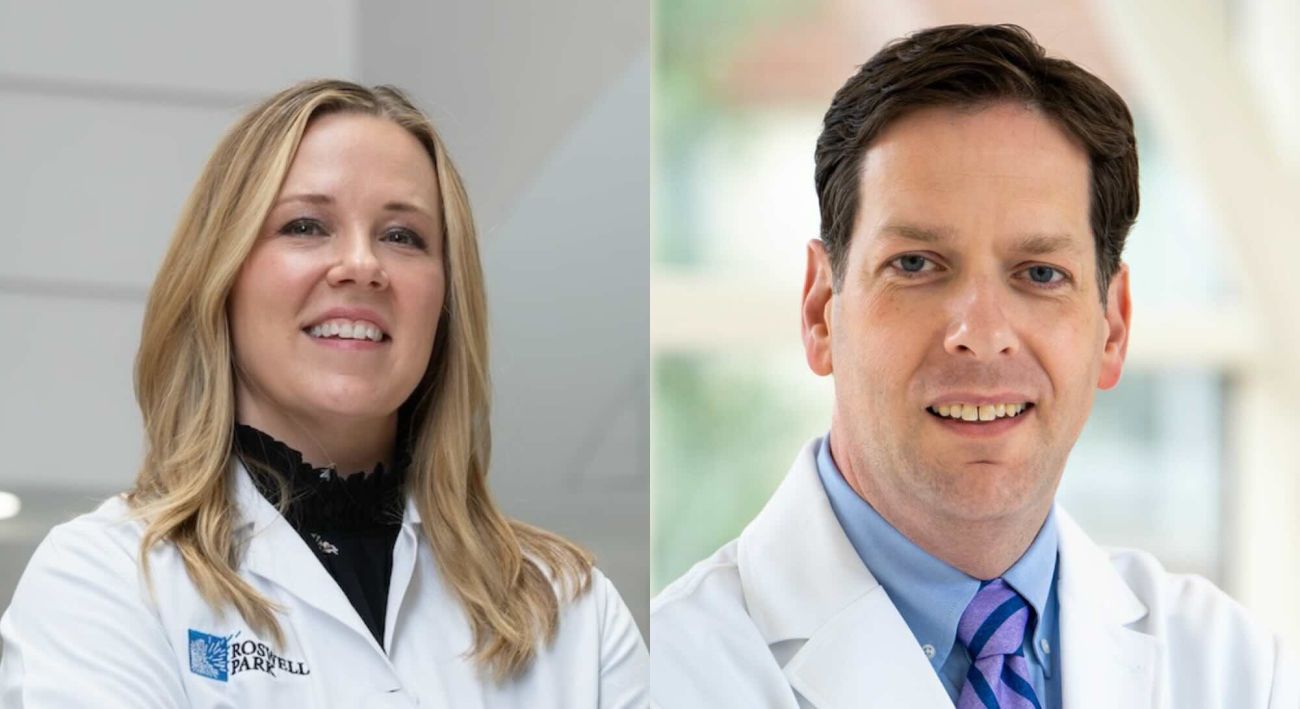
Study led by Roswell Park’s Dr. Brian Betts and Dr. Shernan Holtan highlighted in Blood Advances
- Clinical trial added targeted therapy VIC-1911 to standard treatment
- Takeaway: Inhibiting aurora kinase A can lead to improved outcomes
- Results indicate favorable safety profile, promising outcomes
BUFFALO, N.Y. — Results of a phase 1 clinical trial show that patients who undergo a blood stem cell transplant involving a donor have a lower risk of relapse and lower rates of graft-versus-host disease when they receive the targeted therapy VIC-1911 along with the standard-of-care regimen that includes post-transplant cyclophosphamide and sirolimus. Led by Shernan Holtan, MD, Chief of Blood and Marrow Transplantation, and Brian Betts, MD, Vice Chair of Strategic Initiatives for Transplant and Cellular Therapy at Roswell Park Comprehensive Cancer Center, the study appears in Blood Advances, a journal of the American Society of Hematology.
A donor or “allogeneic” stem cell transplant is a treatment option for many patients with leukemia, lymphoma or other blood cancers or disorders. Graft-versus-host disease (GVHD) is a life-threatening side effect that can occur when the donor’s immune cells perceive the patient’s body as foreign and attack it. But reducing the risk of GVHD by giving the patient immune-suppressing drugs can also weaken the cancer-killing potential of the donor’s stem cells — a beneficial response called the graft-versus-tumor effect.
“This study addresses the main challenge that remains in our field — relapse,” says Dr. Holtan. “It’s amazing that the relapse-prevention intervention in this study, the use of VIC-1911, appears to have a role in preventing GVHD, too. It was an honor to translate this laboratory breakthrough from Dr. Betts’ lab into a first-in-class phase 1 study with promising early results.”
Findings of this study demonstrate that the VIC-1911/cyclophosphamide/sirolimus regimen achieves a beneficial balance between those favorable and nonfavorable effects of treatment. One year after transplant, none of the patients enrolled in the clinical trial saw their disease return, as compared with relapse rates as high as 22% for those who receive post-transplant cyclophosphamide and sirolimus without VIC-1911. No patients had experienced grade 3-4 acute GVHD by 180 days after transplant, and there were low rates of moderate or severe chronic GVHD (6%).
Research in the laboratory demonstrated that GVHD prevention could be improved by combining sirolimus (brand name Rapamune) with VIC-1911, which inhibits Aurora kinase A (AURKA). An oncogene, AURKA can promote the proliferation of cancer cells and drug resistance when it is overexpressed. The third element in the regimen, cyclophosphamide (brand names include Cytoxan), is a chemotherapy drug shown to dramatically reduce the risk of GVHD when combined with other GVHD-prevention drugs administered after transplant.
In addition to the lead authors from Roswell Park, the research team includes contributors from the University of Minnesota at Minneapolis, the National Cancer Institute, the Blood and Marrow Transplant Group of Georgia in Atlanta and VITRAC Therapeutics of Natick, Massachusetts.
###
From the world’s first chemotherapy research to the PSA prostate cancer biomarker, Roswell Park Comprehensive Cancer Center generates innovations that shape how cancer is detected, treated and prevented worldwide. The Roswell Park team of 4,000+ makes compassionate, patient-centered cancer care and services accessible across New York State and beyond. Rated “Exceptional” by the National Cancer Institute, Roswell Park, founded in 1898, was one of the first NCI-designated comprehensive cancer centers in the country and remains the only one in Upstate New York. To learn more about Roswell Park Comprehensive Cancer Center and the Roswell Park Care Network, visit www.roswellpark.org, call 1-800-ROSWELL (1-800-767-9355) or email ASKRoswell@RoswellPark.org.
Jane Rose, Media Relations Specialist
716-845-4919; jane.rose@roswellpark.org