- Clinical trials provide access to promising new treatments
- T-cell engagers emerge as a breakthrough treatment for small cell lung cancer
- Comprehensive cancer care goes beyond treatment alone
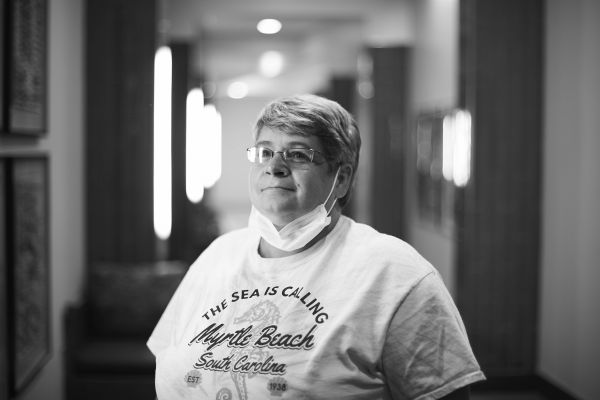
Last summer, when Patricia learned she had stage 4 small cell lung cancer, it felt like bad news on top of bad news.
She was already struggling with ongoing treatment after undergoing surgery at another facility to remove a brain tumor. “I was on more than ten medications and going downhill. I had an infection in my port. I needed to use a walker. I was very sick and kept saying something was wrong. But I didn’t feel heard.”
When a CT scan found that she also had lung cancer, “that’s when I decided I better go to Roswell,” she says.
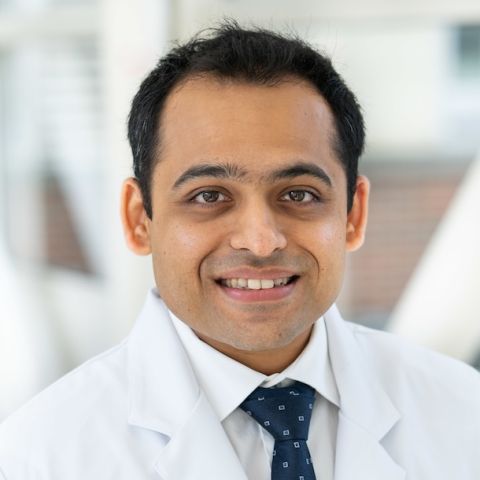
After meeting with medical oncologist Prantesh Jain, MD, FACP, who specializes in lung cancer and leads clinical trials in the disease at Roswell Park Comprehensive Cancer Center, everything was different. He explained that her lung cancer was an aggressive type called small cell lung cancer. She was also admitted to the hospital promptly because her kidneys were failing. Eventually, Patricia was well enough to begin chemotherapy.
Then Dr. Jain told her about a clinical trial that she could consider. The phase 1 trial was studying a new drug called a T-cell engager. A type of immunotherapy, T-cell engagers work differently from chemotherapy. Instead of attacking any fast-dividing cell, these drugs point a patient’s own immune system at the cancer.
A game changer for a difficult cancer
This new class of drugs is changing the outlook for these aggressive lung cancers. “T-cell engagers are one of the most exciting advances we’ve seen in small cell lung cancer in many years,” says Dr. Jain. “Unlike chemotherapy, which attacks any fast-dividing cell, these drugs point a patient’s own immune system at the cancer.
This approach is still fairly new in lung cancer. One T-cell engager, tarlatamab, is now FDA-approved for people whose extensive-stage small cell lung cancer has grown after chemotherapy, and several others — including the one in Patricia’s trial — are being studied in clinical trials. “These drugs do have side effects that are different from chemotherapy,” says Dr. Jain. “The immune system can go into overdrive, causing fever, low blood pressure, or confusion so patients are watched closely, especially with the first few doses. But once patients get through that early period, many tolerate treatment well for a long time.”
T-cell engagers seek out a specific protein on the patient’s cancer cells and a specific target on their own immune system’s T cells, creating a bridge that brings the two types of cells together. This forced proximity triggers the T cells to release substances that dissolve the cancer cell. This particular study drug was designed to seek out a protein called delta-like ligand 3 (DLL3), a protein found on the surface of most small cell lung cancer cells, including the cells in Patricia’s tumors.
Patricia was hesitant at first but agreed to enroll in the clinical trial. “I thought the trial might just be buying me some time. I was thinking I would do whatever I needed to do to stay alive.”
Clinical trials offer new treatment options
Lung cancer is always a challenging diagnosis, and the “small cell" subtype is known to be aggressive. It tends to grow and spread quickly and often becomes resistant to chemotherapy.
“Clinical trials matter because they can give patients access to promising new treatments years before those treatments are widely available,” Dr. Jain says. “Every real advance we’ve made in lung cancer came from clinical research. For an aggressive cancer like small cell lung cancer, a trial can offer another option when standard treatment alone isn’t enough. Clinical trials don’t replace excellent cancer care — they’re part of it. They let us combine today’s best treatments with tomorrow’s.”
Today, a year later, Patricia is showing an exceptional response and there is no evidence of disease progression. Her lung tumors are shrinking, with one 40% smaller. “It’s working for me,” she says. “I will probably stay on this drug forever.”
You have time for a second opinion
A second opinion from a multispecialty team that focuses on lung cancer every day is important — we will ensure you get it without delay.
Supportive and palliative care makes a difference
Sensing that Patricia could use some extra help, Dr. Jain also connected her with services in Supportive and Palliative Care, which focus on improving quality of life and relieving symptoms, side effects and stress.
“I had lost a lot of weight and was feeling weak, and at times I just wanted to give up,” Patricia says. She met with Elizabeth Bowdish, MD, who prescribed a prescription medicine related to cannabis that helped restore her appetite and strength. She also met with a psychiatrist to sort through her feelings of despair.
“I was ready to give up last August,” she says. Now, she’s setting her sights on other goals. “I’m looking forward to spending more time with my three grandsons and to possibly go into remission. I want to resume our month-long family vacations in Myrtle Beach. To live, happy and healthy. I found hope at Roswell Park.”
Research transforms cancer care for lung patients
“For many years, progress in small cell lung cancer lagged behind other cancers,” Dr. Jain says. “We didn’t see the wave of new treatments that transformed diseases like melanoma or some forms of breast cancer. That has changed dramatically in the past several years. We’re now seeing real breakthroughs: immunotherapy, targeted therapies for certain patients, antibody-drug conjugates and T-cell engagers. What gives me hope is that we finally understand the biology of this disease much better, and that’s leading to smarter, more personalized treatments. Stories like Patricia’s remind us why research matters. Every advance starts with patients who join clinical trials and help move the field forward.”
Editor’s Note: Cancer patient outcomes and experiences may vary, even for those with the same type of cancer. An individual patient’s story should not be used as a prediction of how another patient will respond to treatment. Roswell Park is transparent about the survival rates of our patients as compared to national standards, and provides this information, when available, within the cancer type sections of this website.