- A strong sense of faith helped her stay determined
- Daily trips to the nurses' station kept Frankie motivated and focused
When undergoing her first type of chemotherapy to fight acute myeloid leukemia (AML) in the hope of having a stem cell transplant, Frances “Frankie” Ciezki never entertained the thought that she might not make it.
The chemotherapy wasn’t working as well as her doctors hoped, removing only 50% of her cancer cells, and she was encouraged to have a quality of life discussion about how she might want to proceed.
“My friend Jennifer is a nurse and, when things weren’t going well, she called me and we had the quality of life discussion,” Frankie says. “I told her, ‘I’m not going to die. I know that God doesn’t want to take me now.’ I had received a scripture verse five years ago, telling me that I was going to get a more genuine faith, but I would have to go through various trials.”
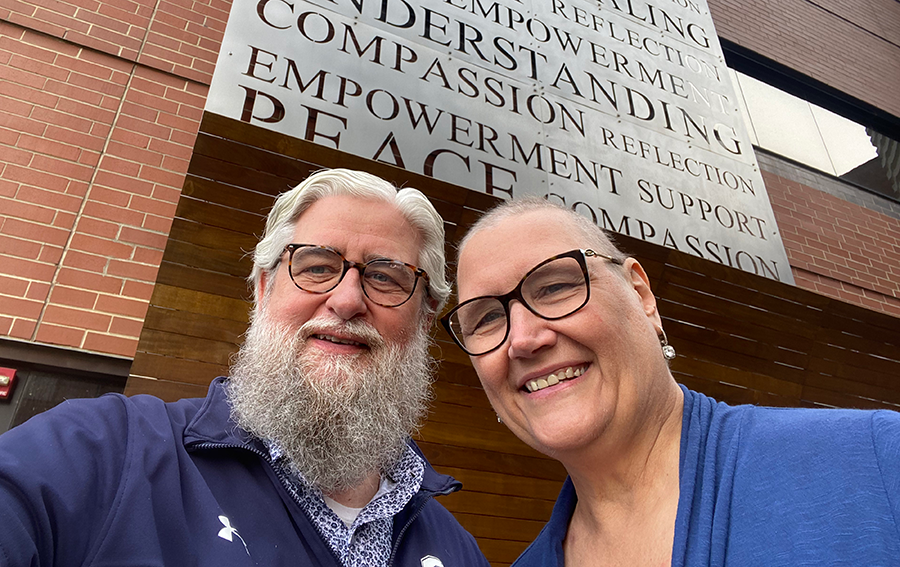
Her strong sense of faith, the care she received from Roswell Park Comprehensive Cancer Center, along with the support of her husband, Robb, and friends and family, got Frankie through those difficult days.
Diagnosis came as a surprise
In January 2025, Frankie was working at Buffalo Medical Group when she had bloodwork done as part of her annual physical. “I had my bloodwork done on Friday and by Monday my primary doctor called and said something’s wrong. My physical was scheduled for that Thursday and they said it might be leukemia,” she recalls.
An oncologist at Buffalo Medical Group told her she would be directly admitted to Roswell Park that same day. “I had no symptoms at all. I felt totally fine! I was at work. It was very shocking. Robb and I got something to eat, started making phone calls and went home, packed a bag and waited for Roswell Park to call with an admission time.”
She and her husband drove to Roswell Park in a snowstorm, received the diagnosis of AML and, the next morning, learned she would have to stay in the hospital for 30 days to get her cancer under control enough for a transplant.
“I turned to my husband and said, ‘I’m being put on a 30-day retreat.’ We believe and trust in Jesus and I believed it was going to be a (spiritual) retreat,” Frankie says. She notified a close friend at work and asked her to let her colleagues know what was going on and to “glorify God in all circumstances.” Another friend started and managed a Caring Bridge website to keep Frankie’s network notified of her progress.
From the time she arrived at Roswell Park, Frankie says her nurses and doctors took wonderful care of her, doing their best to work with her “horrible veins” for blood tests and making her as comfortable as possible: "We have nothing but good things to say about Roswell. They were phenomenal.”
A daily to-do list to stay motivated
The first kind of chemotherapy wasn’t able to knock her cancer load down to the levels needed for a transplant, requiring a second medication which quickly brought her AML under control.
It also brought challenging days when she felt weak and exhausted. “You wake up in the morning and think 'I’ve got to get up,' but I couldn’t get up. I remember having conversations with myself, telling myself to get up, you have to try and do things," Frankie says. She would write a daily to-do list, for motivation, that included simple things like changing out of her pajamas into her “day-jamas,” comfortable and soft clothes that kept her warm while she would brush her teeth — another item on the daily to-do list — and take slow walks around the floor.
Every day she would stop by the nurses’ station and tell the team they were doing a good job. It became a highlight, both for Frankie and the nurses. “I would stop at the nurses’ station, get everybody’s attention, and say ‘Thanks for coming to work today,’” she laughs. “There was one time I cried and asked, ‘What would we all do if you weren’t here?’” grateful for their attention and hard work.
She learned there were some days she just didn’t have the strength to get up, or that standing for a prolonged period of time could have been very dangerous. “That was one of the learning curves, to listen to your body and know what you can and can’t do,” she says. “It’s hard. Accepting that people want to do things and help, because I wanted to do things. But I had to accept where I was and what was happening.”
Transplant & Cellular Therapy
Learn about Roswell Park's expertise with stem cell transplants.
Letting her loved ones help her through
Her initial 30-day hospital stay lasted a little longer than expected, but Frankie was able to go home in March, before her transplant in July 2025, under the care of medical oncologists and transplant specialists Philip McCarthy, MD, Shernan Holtan, MD and Steven Green, MD. Frankie remembers being a little nervous to return to Roswell Park, knowing how she’d felt when she was admitted the first time, but she tried to remain calm and keep her faith.
The transplant itself “took 37 minutes,” she recalls. “It’s amazing how quick it goes, it’s so fast.” After that, she had two more days of chemotherapy, to ward off graft-versus-host disease, a potentially life-threatening complication that used to be a common risk for transplant patients but, thanks to new protocols in place at Roswell Park, is now very rare. A week later, Frankie went home.
“Dr. McCarthy told me, ‘the next two months are not yours, they are ours, and in September, you can start getting your life back,’” she says. She relied on Robb, her friends, and family, for just about everything during that time. They made adjustments to their home to make it easier for Frankie to get around and be safe; they managed her nausea and discomfort and made sure she didn’t feel guilty about the days when all she could do was sleep.
“Then September came, and Robb went back to work at St. Mary’s High School in Lancaster. Friends started taking me to my visits. It was very slow progress. Going from one room to another, I’d have to sit down and rest to recover before going to the next room. It was very slow going, but every day I’d wake up and say what can I physically do today,” she says.
“Grateful for everything”
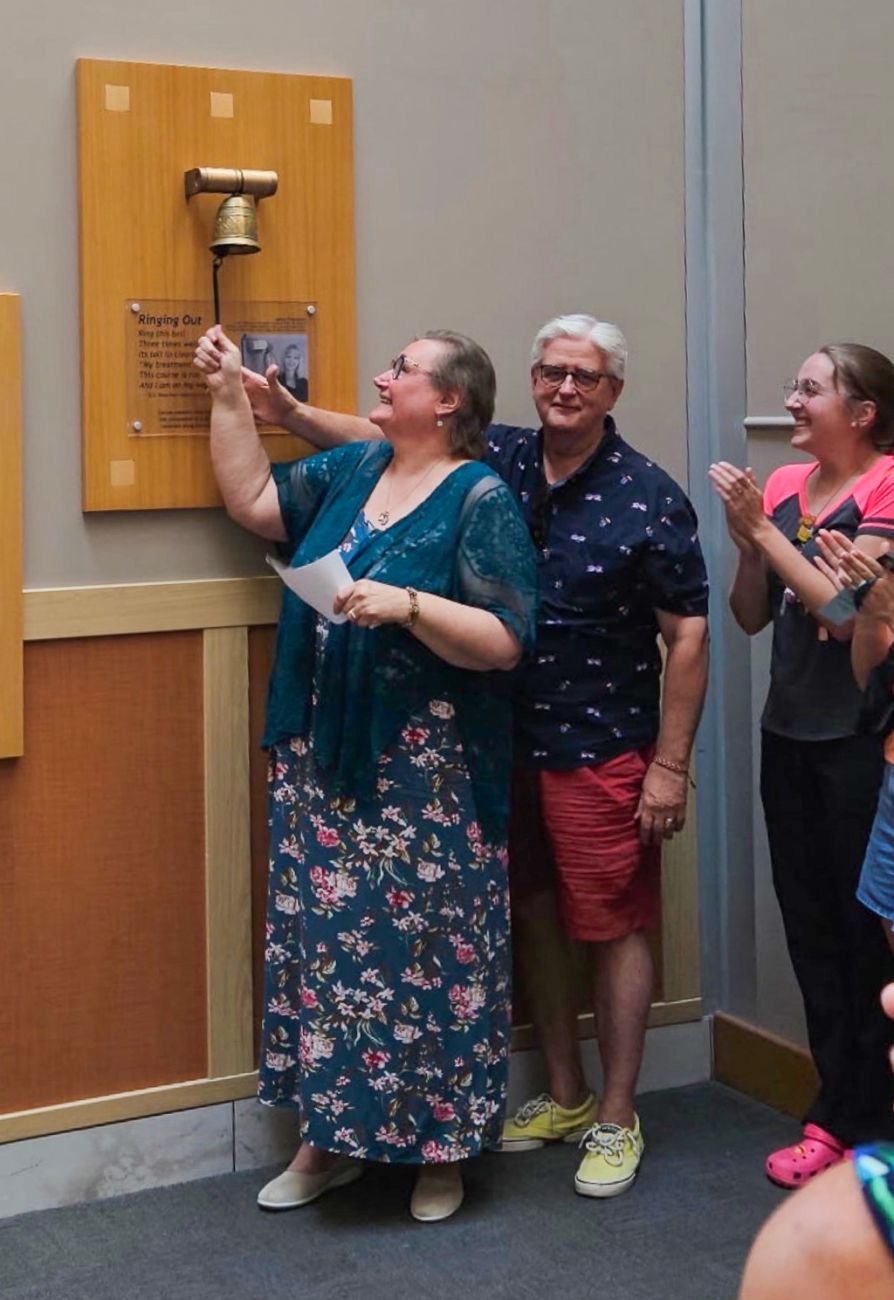
Bit by bit, Frankie got her strength back, enough to ring the Victory Bell at Roswell Park in August 2026, surrounded by Robb, her family, friends and some of the nurses. She still gets tired more quickly than before but stays optimistic. “I’m going to put forth the best. That’s just me,” she says. “I feel great. I’m up to walking eight, nine houses (down the street) and back.”
Frankie continues her survivorship care with her team at Roswell Park and listens to her nurses, following their orders for bone density tests and dermatology checks. “I’ll do whatever they tell me to do,” she laughs. “We keep moving forward. Everybody’s been just wonderful, the nurses, the doctors, the managers, the receptionists; everyone. I’m so grateful to be in Buffalo, where Roswell Park is. I could not have gone to a better place when this happened. In hindsight, I’m grateful for everything we’ve gained in our quality of life, our deepening faith and being together, Robb and me.”
Editor’s Note: Cancer patient outcomes and experiences may vary, even for those with the same type of cancer. An individual patient’s story should not be used as a prediction of how another patient will respond to treatment. Roswell Park is transparent about the survival rates of our patients as compared to national standards, and provides this information, when available, within the cancer type sections of this website.