Unlike other cancer types, testicular cancer is more common in young adults than in older men.
Valentine’s Day is usually when people’s minds turn to thoughts of hearts and flowers. For Nate Geary, it’s the day he was diagnosed with testicular cancer, making it special in an unexpected way.
His diagnosis was the culmination of two months of unexpected abdominal pain that didn’t register for a few months as anything out of the ordinary for his primary doctor.
“I was experiencing pain almost in the region of what I would think was my appendix, but my primary doctor, on three separate occasions, said he wasn’t really seeing anything there,” Nate says. “By the third time I got sent home with ‘you’re fine,’ I was getting very frustrated. After two and a half days in bed, I woke up in a pool of sweat and I got my dad to take me to the emergency room.”
He told the doctors that he’d lost 15 pounds over the last few months and insisted something was wrong. They asked him to call his urologist. “I said I’m 24, I don’t have a urologist. My grandfather does, but I don’t.”
As luck would have it, one of the specialists on the list provided by his doctor was in the emergency room that day and, when Nate called to make an appointment, he was told to come in the next morning. The doctor looked at Nate’s test results and diagnosed him with testicular cancer, something that is not normally considered for young men in otherwise good health.
Curable when caught early
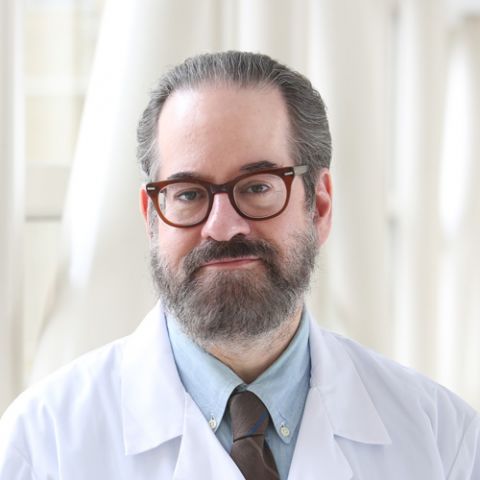
Testicular cancer is typically a young man’s disease, says Ellis Levine, MD, a medical oncologist at Roswell Park Comprehensive Cancer Center. Cases are most commonly diagnosed in men between their late teens and early 20s, with fewer cases diagnosed in men in their late 30s and early 40s.
“It’s uncommon to see a man in his 50s or 60s with testicular cancer,” Dr. Levine explains.
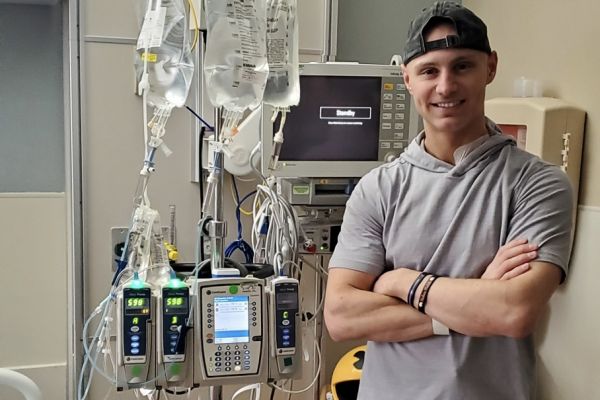
Nate had a quick course of action after he was diagnosed: Surgery was scheduled for three days later to remove the tumor, with a follow-up appointment with Dr. Levine one week later to determine his next steps.
“They were able to remove the tumor and luckily it hadn’t spread, which was everyone’s biggest concern,” Nate says. “Dr. Levine gave me a lot of options, including the option of coming back every two months for a while, then every three months, then semiannually, then once a year.”
If surgery is found to have removed the tumor fully, most testicular cancer patients will not have a recurrence, Dr. Levine says. He adds that it is “not a subtle cancer.” It can grow rapidly if it recurs but is very curable when found early.
“The earlier you find it, the higher the rate of cure. Nate had stage one testis cancer. The majority of recurrences happen within the first 12 to 18 months after orchiectomy, in which the testis is removed. A stage one cancer carries an overall relapse risk of 20-30%, or a 70% cure rate,” he says. “After five years, it’s very unusual for the cancer to come back.”
The most common symptom of testicular cancer is pain and/or enlargement of the testicle and, if the cancer has spread or recurred, abdominal pain, Dr. Levine says, adding that it’s fairly easy to conduct regular self-exams in the shower to determine if anything has changed in the testicles or scrotum. He also notes that testicular cancer remains a rare disease, with three or four cases diagnosed per 100,000 men.
Why Roswell Park for testicular cancer
Testicular cancer is a rare cancer, and young adults are rare patients — which means you need a higher level of care that can only be found a comprehensive cancer center.
Sharing and speaking out to help others
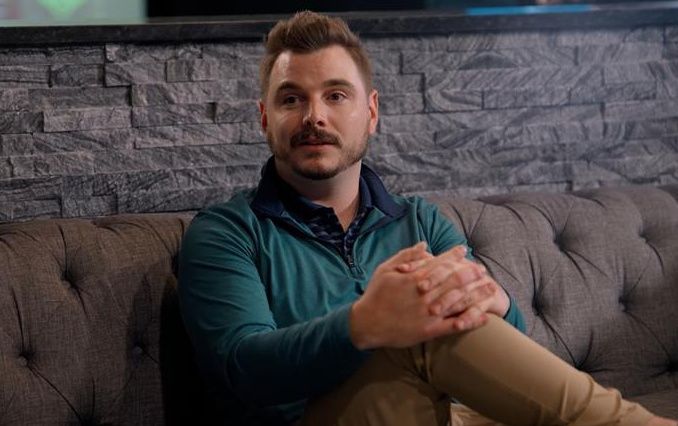
Now 10 years past his diagnosis, Nate is in his mid-30s, in good health and occasionally plays golf with his urologist. He no longer needs to come to Roswell Park for survivorship care, but he does make sure to go in for annual visits to confirm his cancer has not returned.
After some initial hesitance to talk about the exact kind of cancer he had, Nate has become an advocate for others. Through a partnership with Audacy, the parent company of sports radio station WGR 550 where he works as an on-air host, he is featured as one of the Men of WGR in a partnership with Roswell Park to advocate for men to take control of their health.
“Roswell was kind of my soft landing. There’s a certain level of comfort, especially early on, walking through those doors, knowing I’m lucky that I live here in Buffalo and so close to this place,” says Nate, who adds he can see the hospital from his home.
He hopes, by sharing his story, to encourage more men to pay attention to their health — especially young men.
“I think it’s really hard for men in general. There’s this expectation for men to suck it up and that asking for help is weakness, and the perspective I took is I’m glad that I didn’t just accept what my primary doctor said and kept going and asking for help,” he says. “If I had waited longer to go to the ER, it’s possible this would be a very different conversation. My persistence in saying no, this isn’t OK, I need help, it was intimidating but it was super important.”
Nate continues to meet more men, from all walks of life, who are testicular cancer survivors as well. It was a little embarrassing to name his cancer at first, but it’s no longer a factor.
“The floodgates opened a little bit. I have a very strong, positive feeling when people talk about Roswell and I always want to be someone who talks about it,” he says. “I had such a positive experience. I went from no one listening to immediately knowing I was heard and they gave me a very clear, concise plan. I felt my confidence level was rebuilt because I felt I was in the right hands.”
Editor’s Note: Cancer patient outcomes and experiences may vary, even for those with the same type of cancer. An individual patient’s story should not be used as a prediction of how another patient will respond to treatment. Roswell Park is transparent about the survival rates of our patients as compared to national standards, and provides this information, when available, within the cancer type sections of this website.