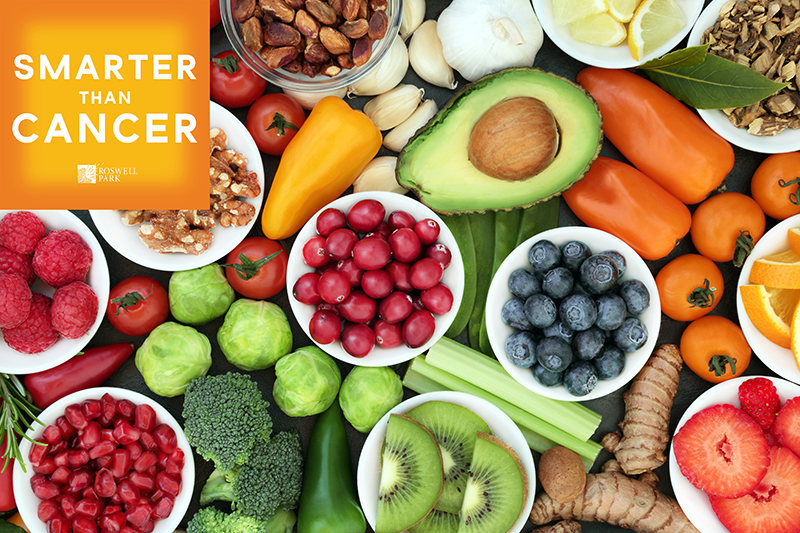
Eating a healthy diet can feel like a stressful premise, with seemingly conflicting advice published every other week. Concerns that a “bad” diet or “unhealthy” foods might increase your risk of developing cancer can add to that stress.
Debunking nutritional myths
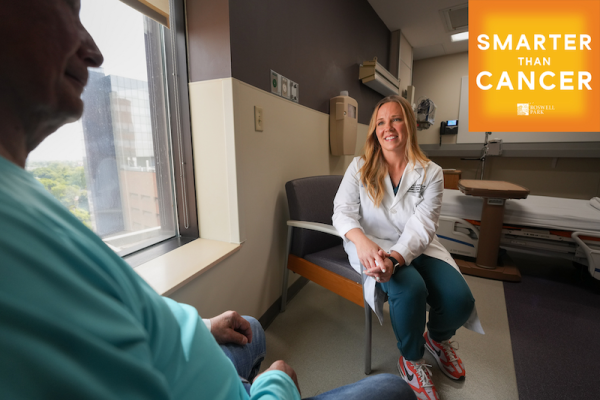
Soybeans, for example, were once embraced as a healthy food and source of protein, until it was suggested that soy isoflavones might be dangerous because their chemical structure is very similar to estrogen. “We were scared that it’s going to act like estrogen and it’s going to increase the risk of breast cancer and cause breast tumor growth,” says Kayla Kio, MS, BS, RD, a registered dietitian at Roswell Park Comprehensive Cancer Center.
Studies to explore that risk found that the amount of soy isoflavones that resulted in an increased risk of tumor growth in preclinical models “would never occur in a human,” she says. “The other piece is that the soy isoflavones are not broken down in the same way in a human,” as they are in other species.
Another nutrient that gets blamed for cancer is sugar. “Sugar feeding cancer is a myth,” Kio says. “Everyone’s afraid of sugar, including from fruit, when they hear this. I don’t want you to be terrified that the moment you eat something sweet, now you’re feeding cancer in your body.”
Glucose from food is the fuel that powers our brains, she says. “It has to constantly be at a certain level in your blood because it feeds your brain. Your brain can’t run off of proteins or fats or energy, specifically, it has to use glucose, which comes from carbs.”
Portion size is key, for foods deemed “healthy” as well as those looked upon as “unhealthy,” adds Karen Yeary, PhD, a nutritional specialist at Roswell Park. “If you take something that’s ‘healthy’ like carrots, which are rich in vitamin A, and if you eat too much of it, you’ll die from vitamin A toxicity. It’s all about portion and moderation.”
Your body weight plays an important role in cancer risk
And then there’s obesity.
“Being overweight and/or obese places your body in a sub-inflammatory state, and inflammation is what makes it so the body is more likely to be at risk for cancer happening,” Dr. Yeary says. “It puts your body in a state where it facilitates cancer.”
An estimated 20% of cancer deaths in women, and 14% of cancer deaths in men, are linked with obesity, she says.
“It’s a complicated disease. That’s why it’s been increasing over time despite all this research,” linking it with cancer and also identifying its root causes, Dr. Yeary says.
“There’s a lot of what we call gold standard complex interventions that we know work, but it’s not feasible for the average person to do. Encouraging people to eat 500 fewer calories a day, but it’s an extensive six month to 18 month program where we ask people to write down what they eat, what time they eat it, figure out the calories and the fat, calculate all of that and make sure it’s under, that they’re meeting those needs — it’s just the tip of the iceberg.”
She tried it herself before suggesting it to her patients and found it to be a struggle and a lot of work.
It’s better to start with small changes and focus on things that can be maintained, Kio says. “Let’s take some healthy snacks and make sure you drink enough water. Then we can get to some specific meal plans we can do. Don’t change everything at once. Small changes at a time is huge for anybody.”