At Roswell Park, patients as old as 85 can undergo transplant
Until recently, people aged 70 and older diagnosed with leukemia and other blood cancers were often considered ineligible for a stem cell transplant.
But today — and uniquely at Roswell Park Comprehensive Cancer Center — blood cancer patients as old as 85 are being treated successfully with stem cell transplants that significantly enhance survivorship. Innovations in the prevention and treatment of graft-versus-host disease (GVHD) co-led by physician-scientist Shernan Holtan, MD, Chief of Blood and Marrow Transplantation at Roswell Park, have reduced the fatal organ toxicity that has historically been associated with transplantation.
“We have certainly transplanted people (at Roswell Park) into their early 80s and they are doing well,” she says.
A new approach to transplantation
Improving the prevention and treatment of GVHD, a serious and potentially fatal complication, has significantly changed the ability to offer stem cell treatment to older blood cancer patients. GVHD occurs when immune cells from a donor (the graft) attack your body (the host).
Dr. Holtan’s landmark clinical work and research focusing on reducing organ toxicity and relapses for patients undergoing stem cell transplantation was published in 2023 in the New England Journal of Medicine.
“Before this change in 2023, approximately half of the patients getting an allogeneic transplant would get graft-versus-host disease, and around one in nine or ten patients would die from it. The risk of death was even higher in older adults. With our new approach, now only about 5% of people even get clinically significant graft-versus-host disease,” she reports.
“The data that supports this was recently published, including a specific analysis for patients over 70 going through an allogeneic transplant. In patients over the age of 70 enrolled on our clinical trial, the chance of being alive at one year, doing well, was greater than 90%.”
Less toxicity, better GVHD outcomes
A stem cell transplant is an intensive and complex treatment designed to rebuild the immune system so it can fight cancer. The first successful transplant using bone marrow grafts took place in 1958, when French oncologist Georges Mathé treated six nuclear scientists who had been accidentally exposed to radiation. Those earliest transplants made it clear that GVHD would be one of the greatest challenges to overcome and laid the foundation for today’s advances in transplantation. That work continues here at Roswell Park.
Graft-versus-host disease is a serious risk associated with allogeneic stem cell transplants, which use donor cells from a relative or volunteer registry. Because these donated cells are recognized as foreign, the immune system may respond by attacking the patient’s own tissues, leading to GVHD. The risk of developing severe or life-threatening GVHD increases with age, making careful donor selection and preventive strategies especially important.
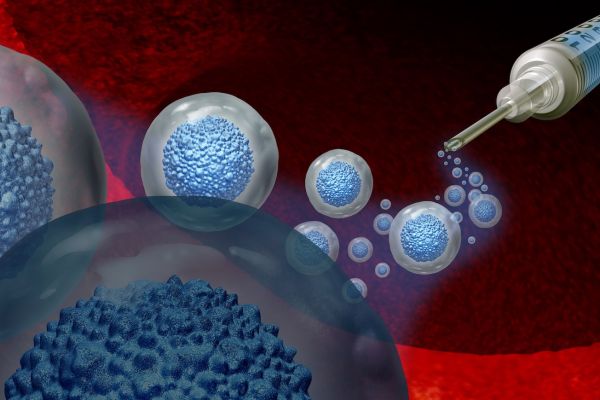
While an autologous transplant uses your own repurposed stem cells, an allogeneic transplant is used to treat blood cancers like leukemia and myelodysplastic syndromes, where the blood-forming stem cells themselves are diseased. For most patients with these diseases, a donor stem cell transplant is the only chance of achieving a cure.
“For most adults diagnosed with leukemia, chemotherapy alone is not curative,” explains Dr. Holtan. “We can now analyze the molecular profile of the leukemia at the time of diagnosis and often predict whether a stem cell transplant will be needed. In fact, about 80% of patients have genetic markers that suggest chemotherapy won’t be enough. A transplant recommendation is not rare—it’s the norm.”
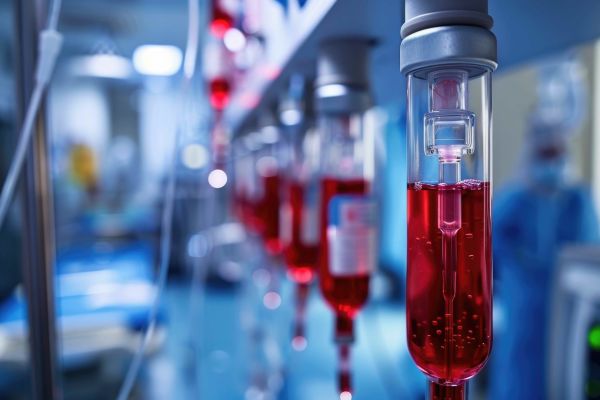
Strong chemotherapy, and sometimes radiation, is given in advance of an allogeneic stem cell transplant to prepare your body to receive and accept the new stem cells. Without this, your immune system would reject donor cells. After infusion, it takes two to three weeks for your blood count to begin to recover. GVHD can happen later when the new immune cells become overactive and begin attacking healthy tissue. In Dr. Holtan’s new approach, chemotherapy is administered on day three and day four after the stem cells are given to target the rapidly dividing rogue immune cells. Eliminating these rapidly dividing immune cells helps to protect healthy cells and tissue, and ensures your body accepts the new cells and allows them to mature without the onset of GVHD.
Lowering the toxicity in the new approach to stem cell transplantation has enabled older adults to better tolerate the process.
“The field has made major strides by developing less toxic chemotherapy and significantly reducing the risk of GVHD,” says Dr. Holtan. “That innovation, particularly the progress in GVHD prevention, is what truly transformed transplant care in 2023.”
It's not too late for a second opinion
Our team uses the latest strategies and technologies for optimizing survival and cure rates and decreasing risk for complications.
“We don’t want people to rule out a stem cell transplant before hearing about the advances in safety and outcomes,” Dr. Holtan says. “Many individuals are relying on outdated information, and in some cases, their doctors may be as well.” She adds that Roswell Park has launched community outreach efforts to educate more people about the latest safety protocols and improvements in transplant care.
“The most important message is this: please schedule a consultation,” she urges. “Don’t let age be a barrier. Let an expert evaluate your risks, the benefits and treatment plan if it is indeed right for the patient. It’s more about someone’s risk and their overall fitness. A transplant may still be a very reasonable undertaking for a patient who is 85 years old but may otherwise live many more years if not for their cancer diagnosis.
Dr. Holtan also advises that chronic conditions common among older adults – such as heart disease, lung disease, diabetes and obesity – do not necessarily make them ineligible for a transplant.
“The biggest barrier to transplant right now is kidney disease. Because the drugs we use can be hard on the kidneys or accumulate and cause toxicity if the kidneys aren’t working well, the kidneys do need to be in reasonably good condition. This is the next challenge for the field—figuring out how to safely deliver transplants and maintain strong outcomes in patients with kidney damage,” she says.
“These conversations can be difficult, but the improved safety of stem cell transplantation offers an opportunity to re-evaluate how we approach treatment decisions. The progress in transplant safety is reshaping what is possible for patients and how clinicians should talk about it. We owe it to patients to make sure our guidance reflects today’s science, not yesterday’s limitations.”