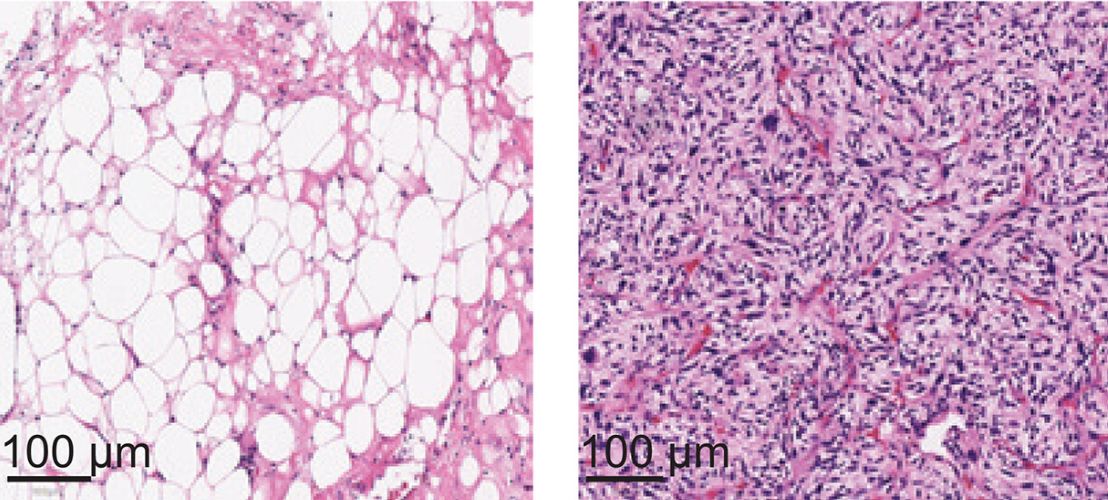
Discovery highlights potential targets to help manage this rare cancer, which frequently recurs despite treatment
- Team discovers that a key protein regulates development of stem-like cells
- Results explain how one tumor can contain both more- and less-aggressive cells
- Findings published in new study in Science Advances
BUFFALO, N.Y. — New research from an expert in cancer biology explains what triggers liposarcoma cells to become more- or less-aggressive and identifies potential targets that could keep aggressive tumors in check. A study led by Blake Wilde, PhD, of Roswell Park Comprehensive Cancer Center highlights how this important discovery may pave the way to new treatment options for this cancer.
More than half of all people with liposarcoma will see their cancer return after treatment, underscoring the need for new and better treatment options. The two most common types of this cancer that begins in fat tissues are well-differentiated (WD) and dedifferentiated (DD) liposarcoma, explains the study’s first author, Blake Wilde, PhD, Assistant Professor of Oncology in the Departments of Urology and Cell Stress Biology at Roswell Park.

While WD liposarcoma tends to grow slowly and usually can be managed with surgery, DD liposarcoma grows faster and is more likely to spread and resist treatment. One tumor can contain both types in different regions, with the dominant type affecting how the cancer behaves.
In some cases, WD tumor cells rapidly become DD cells, while some DD tumors begin to grow more slowly. At the same time, some tumors are found to have changed from one type to another when they reappear after treatment. What causes these transformations?
Using single-nucleus RNA sequencing, Dr. Wilde and a team of colleagues analyzed tissue samples from patients with liposarcomas that contained both WD and DD regions. They discovered the presence of tumor cells similar to stem cells that can transform into either WD or DD liposarcoma cells to resupply different regions of the tumor.
“We found that a protein called PPAR-gamma acts as a switch that helps determine whether these stem-like cells will develop into the more mature, fat-like state of well-differentiated liposarcoma or remain in the immature, rapidly growing state of dedifferentiated, or poorly differentiated, liposarcoma,” he says.
“This discovery explains how different forms of liposarcoma can arise and be maintained within the same tumor,” says Dr. Wilde. "It also points to the stem-like cells and biological programs that may need to be targeted to prevent a manageable tumor from progressing into a more dangerous form.”
Dr. Wilde’s work on the study began when he was a postdoctoral scholar at the University of Southern California Los Angeles (UCLA) and was conducted with co-authors from UCLA.
###
From the world’s first chemotherapy research to the PSA prostate cancer biomarker, Roswell Park Comprehensive Cancer Center generates innovations that shape how cancer is detected, treated and prevented worldwide. The Roswell Park team of 4,000+ makes compassionate, patient-centered cancer care and services accessible across New York State and beyond. Rated “Exceptional” by the National Cancer Institute, Roswell Park, founded in 1898, was one of the first NCI-designated comprehensive cancer centers in the country and remains the only one in Upstate New York. To learn more about Roswell Park Comprehensive Cancer Center and the Roswell Park Care Network, visit www.roswellpark.org, call 1-800-ROSWELL (1-800-767-9355) or email ASKRoswell@RoswellPark.org.
Jane Rose, Media Relations Specialist
716-845-4919; Jane.rose@roswellpark.org