FDA-approved drug abatacept may improve treatment response, prevent some immune side effects
- Results point the way to safer, more effective CAR T therapy for blood cancers
- Investigators hope to launch phase 1B clinical trial
- Findings from laboratory study appear in Blood Cancer Discovery
BUFFALO, N.Y. — While chimeric antigen receptor (CAR) T-cell therapy, an emerging form of immunotherapy, has significantly improved survival rates for patients with multiple myeloma, 30-60% of people with this cancer will eventually relapse. A preclinical study led by Roswell Park Comprehensive Cancer Center has generated critical information to support future clinical studies aimed at reducing the relapse rate and improving patient outcomes, with new findings reported in Blood Cancer Discovery, a journal of the American Association for Cancer Research (AACR).
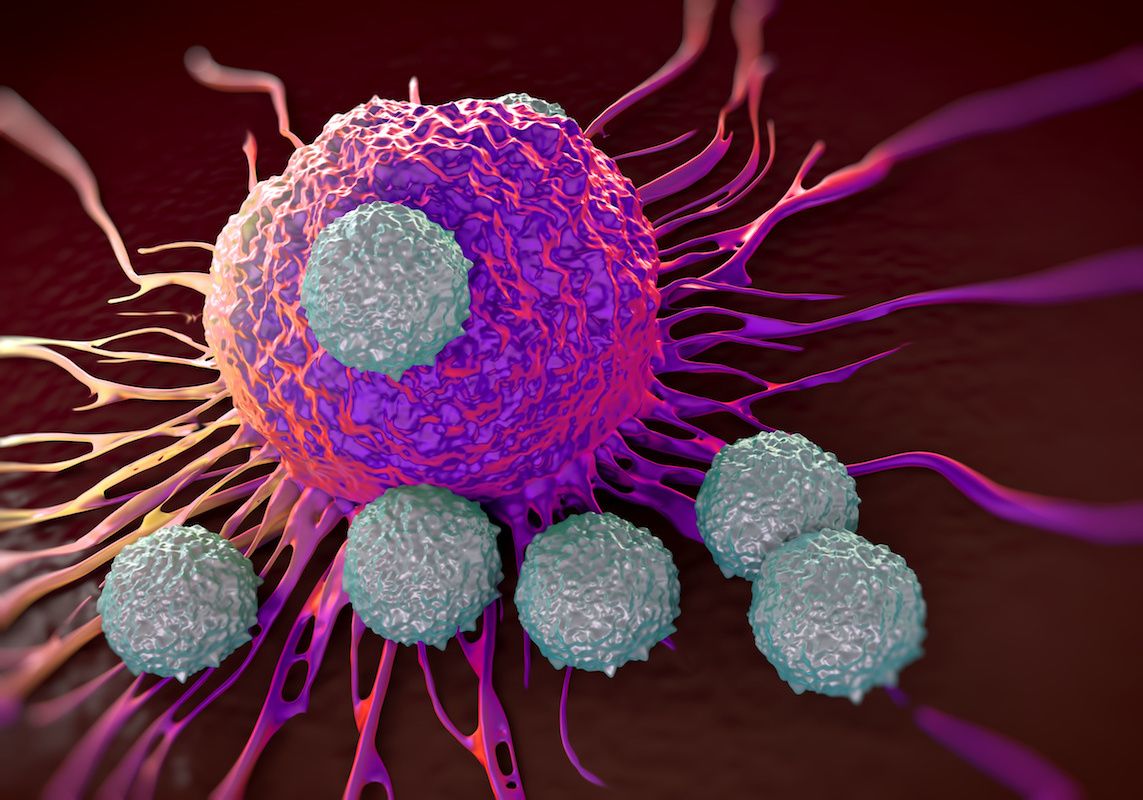
As reported in the new study, a research team led by Scott Olejniczak, PhD, Associate Professor of Oncology in Roswell Park’s Department of Immunology, provided the first direct evidence that the CD28 protein, which is naturally expressed on the surface of T cells and also on some patients’ multiple myeloma cells, affects response to CAR T-cell therapy. CAR T-cell therapy involves removing a patient’s T cells – immune cells capable of killing cancer cells – and inserting genes enabling them to target and destroy cancer cells that carry specific proteins on their surface. The CAR T cells are then multiplied and returned to the patient to fortify the immune system’s anti-cancer response.
But sometimes the immune system overreacts, releasing too many proteins called “cytokines” and resulting in an inflammatory response with serious side effects. Data from the study indicate that this may occur with multiple myeloma and other blood cancers when molecules called “ligands” interact with the CD28 protein on the CAR T cells.
Data from the study also suggest that this toxic overreaction, known as cytokine release syndrome (CRS), can be controlled with the FDA-approved medication abatacept (brand name Orencia), which prevents CD28 from interacting with the CD86 ligand. Blocking CD28 signaling may also improve CAR T therapy responses in some myeloma patients, because when CD28 is expressed on myeloma cells, it promotes their survival.
“We hope the insight gained from this study will lead to better, more effective CAR T-cell therapy options for patients with blood cancers,” says Dr Olejniczak.
In collaboration with co-authors Ehsan Malek, MD, Associate Professor of Oncology and Director of Multiple Myeloma Research at Roswell Park, and Kelvin Lee, MD, PhD, Director of the Indiana University Melvin and Bren Simon Comprehensive Cancer Center, Dr. Olejniczak is developing an early-phase clinical trial to evaluate this strategy in multiple myeloma patients who receive CAR T-cell therapy.
Mackenzie Lieberman, previously a doctoral researcher in Dr. Olejniczak’s lab, is the study’s first author. The research team also represents McMaster University in Hamilton, Ontario.
This work was supported by several National Cancer Institute (NCI) and National Institutes of Health (NIH) grants, award numbers R03CA256122, R01AI155499 (the Ruth L. Kirschstein National Research Service Award), F31CA306124 and T32CA085183 (the NIH Institutional National Research Service Award Training Grant). The work also benefited from Roswell Park shared resources supported through P30CA016056, Roswell Park’s Cancer Center Support Grant from the NCI.
###
From the world’s first chemotherapy research to the PSA prostate cancer biomarker, Roswell Park Comprehensive Cancer Center generates innovations that shape how cancer is detected, treated and prevented worldwide. The Roswell Park team of 4,000+ makes compassionate, patient-centered cancer care and services accessible across New York State and beyond. Rated “Exceptional” by the National Cancer Institute, Roswell Park, founded in 1898, was one of the first NCI-designated comprehensive cancer centers in the country and remains the only one in Upstate New York. To learn more about Roswell Park Comprehensive Cancer Center and the Roswell Park Care Network, visit www.roswellpark.org, call 1-800-ROSWELL (1-800-767-9355) or email ASKRoswell@RoswellPark.org.
Jane Rose, Media Relations Specialist
716-845-4919; jane.rose@roswellpark.org