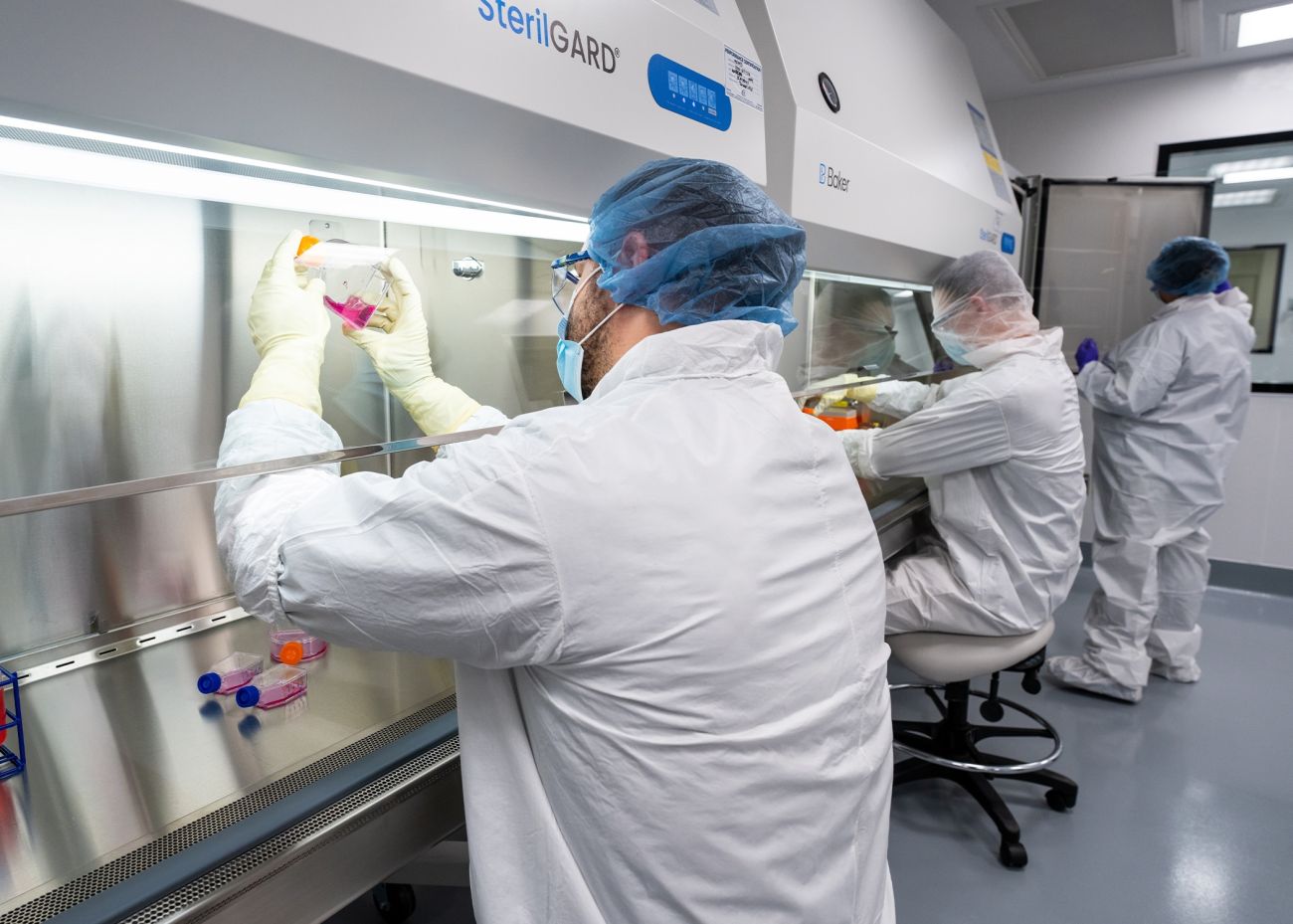
Team headed by Dr. Renier Brentjens finds reprogramming neutrophils is key to antitumor immune response
- Findings appear in the journal Cancer Cell
- Strategy overcomes challenges of the tumor microenvironment
- Clinical trial planned for patients with small cell lung cancer
BUFFALO, N.Y. — A laboratory study out of Roswell Park Comprehensive Cancer Center outlines a new way to boost the effectiveness of chimeric antigen receptor (CAR) T-cell therapy in solid-tumor cancers, resulting in their eradication. Led by Renier Brentjens, MD, PhD, Deputy Director and Chair of the Department of Medicine at Roswell Park and a pioneer in the field of CAR T-cell therapy, the research represents a hopeful new step toward achieving the same success in solid tumors that the treatment has realized in hematological malignancies.
The team, which included first author Yihan Zuo, PhD, and co-senior author Scott Abrams, PhD, is the first to show that CAR T cells armored with the cytokine IL-36 gamma can reprogram white blood cells known as neutrophils to activate an innate immune response against solid tumors. Their findings were published today by Cancer Cell.
“What’s so exciting about this work is that it demonstrates a new mechanism by which CAR T cells can engage a patient’s own immune cells to go after solid-tumor malignancies,” says Dr. Brentjens, who holds The Katherine Anne Gioia Endowed Chair in Cancer Medicine at Roswell Park. “Our findings establish that the IL-36 gamma CAR T-cell platform holds promise as a possible treatment option for some advanced solid-tumor cancers for which there currently are no curative therapies.”
Dr. Brentjens was recognized with the 2024 Warren Alpert Foundation Prize for his contributions to the creation of CAR T-cell therapy, which involves collecting a patient’s own immune T cells and adding a specific gene that enables them to zero in on specific proteins on the surface of cancer cells, targeting them for destruction. The re-engineered cells, called CARs or CAR T cells, are then multiplied and returned to the patient to mount a stronger attack by the immune system.
CAR T-cell therapies have resulted in high remission rates for blood-based cancers, but solid tumors present greater challenges. While CARs are designed to target one or two antigens, solid tumor cells have many different antigens on their surface — and those cells can stop producing antigens to “hide” from the CARs that target them during treatment. At the same time, the protective tissue surrounding the tumor and the overall tumor microenvironment (TME) — the blood vessels, normal cells and other elements that nurture and protect it — make it difficult for CAR T cells to infiltrate the tumor.
Working with preclinical models of small cell lung cancer, the research team evaluated the effectiveness of a CAR T cell designed to target Interleukin 36 gamma (IL-36γ) — a protein that has a broad impact on immune cells, including neutrophils, which are key to establishing the cancer-immunity cycle. Recent studies have shown that subsets of neutrophils can kill tumors directly and induce adaptive anti-tumor immunity, and that they can affect immunotherapy outcomes.
“Our study uncovers an unexpected level of immune collaboration activated by IL-36 gamma-armored CAR T cells,” says study first author Yihan Zuo, PhD, research scientist in Roswell Park’s Department of Medicine. “We were excited to find that neutrophils can be reprogrammed to acquire antigen-presenting functions and drive potent antitumor immunity. These insights open new possibilities for developing next-generation cell therapies for solid tumors.”
The treatment strategy also skips lymphodepletion prior to treatment, a step in standard CAR T-cell therapy that uses chemotherapy to eliminate the patient’s own lymphocytes to make room for the CAR T cells. Sparing the neutrophils means the armored IL-36 gamma CAR T cells can recruit them to the anti-tumor response instead.
“The discovery of this unique CAR T cell/IL-36 gamma pairing defines a breakthrough not only in our basic understanding of the immune-tumor interaction but also a key advance in attacking solid cancers, which has remained a longstanding paradox,” notes study co-senior Scott Abrams, PhD, Jacobs Family Endowed Chair of Immunology at Roswell Park.
The strategy has not yet been assessed in humans. A clinical trial based on these findings is now in development at Roswell Park.
The research team included contributors from seven Roswell Park programs as well as Christopher Hackett, MD, PhD, of Weill Cornell Medicine. The work was funded in part by two grants from the National Cancer Institute (NCI): project numbers U01CA256801 and P30CA016056, Roswell Park’s Cancer Center Support grant from the NCI.
###
From the world’s first chemotherapy research to the PSA prostate cancer biomarker, Roswell Park Comprehensive Cancer Center generates innovations that shape how cancer is detected, treated and prevented worldwide. The Roswell Park team of 4,000+ makes compassionate, patient-centered cancer care and services accessible across New York State and beyond. Rated “Exceptional” by the National Cancer Institute, Roswell Park, founded in 1898, was one of the first NCI-designated comprehensive cancer centers in the country and remains the only one in Upstate New York. To learn more about Roswell Park Comprehensive Cancer Center and the Roswell Park Care Network, visit www.roswellpark.org, call 1-800-ROSWELL (1-800-767-9355) or email ASKRoswell@RoswellPark.org.
Jane Rose, Media Relations Specialist
716-845-4919; jane.rose@roswellpark.org