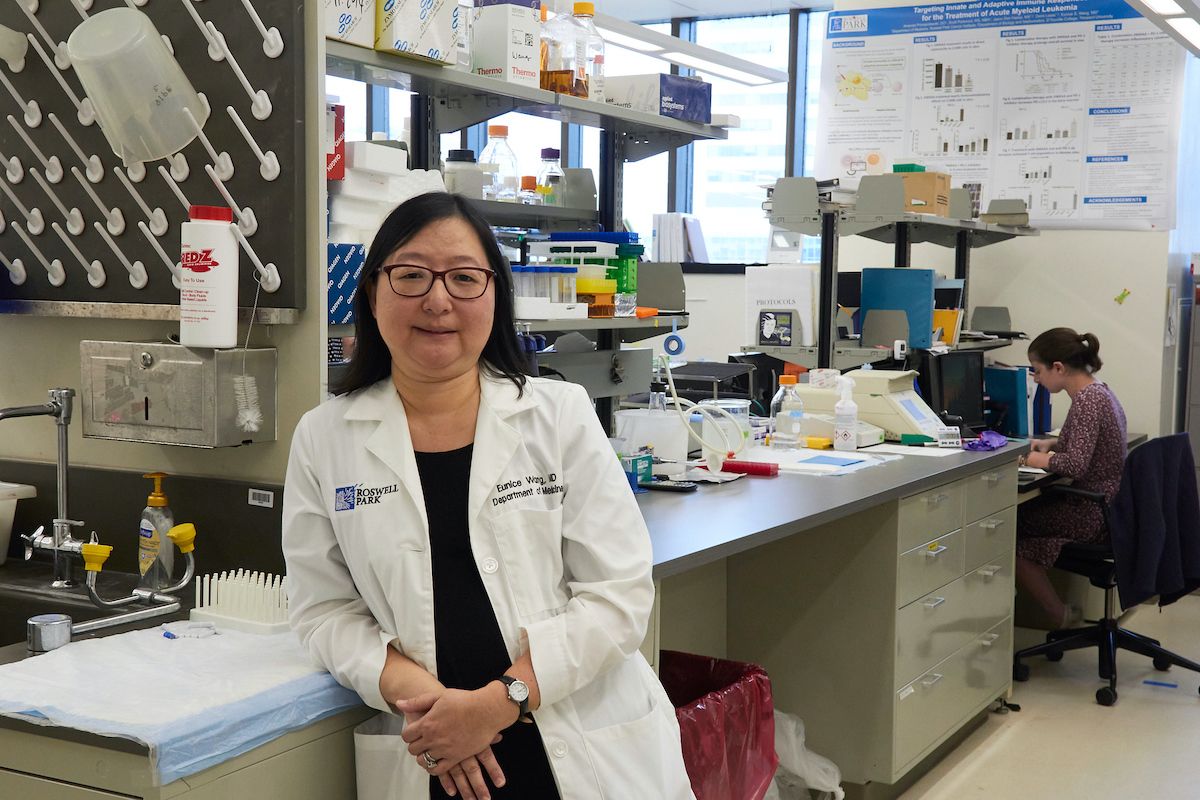
Dr. Eunice Wang and team share findings on crenolanib and ziftomenib combinations targeting multiple mutations
- Findings hold promise for many AML patients with relapsed disease
- Crenolanib + chemotherapy assessed for relapsed AML with FLT3, NPM1 mutations
- Ziftomenib added to chemotherapy for relapsed AML with NPM1m, KMT2A-r AML
BUFFALO, N.Y. — While patients with acute myeloid leukemia (AML) are routinely treated with chemotherapy and other cell-killing therapies, existing options do not lead to favorable clinical outcomes in all patients. Targeting certain mutations in AML patients with specific inhibitor drugs has improved outcomes in 20-30% of cases. The promising results of two clinical trials led by Eunice Wang, MD, Chief of Leukemia at Roswell Park Comprehensive Cancer Center, suggest that combining targeted inhibitors with chemotherapy could induce clinical responses in 60-80% of AML patients with relapsed aggressive subtypes of the disease and prolong overall survival.
The findings of both studies will be presented today at the 67th annual meeting of the American Society of Hematology (ASH) in Orlando, Florida. Every year more than 30,000 professionals from around the world gather at this premier conference to learn about emerging treatments and other important advances in the field.
Crenolanib improves outcomes for AML patients with FLT3 and NPM1 mutations
A randomized, placebo-controlled phase 3 clinical trial led by Dr. Wang and conducted in the U.S. and Europe from 2018-2024 showed that adding the potent FLT3 inhibitor crenolanib to salvage chemotherapy resulted in better overall response rates, longer event-free survival and longer overall survival in patients with relapsed or treatment-resistant AML with an FLT3 mutation, compared with patients who received chemotherapy alone. Outcomes were especially remarkable in patients with AML characterized by both FLT3 and NPM1 mutations.
Crenolanib, a targeted therapy called a tyrosine kinase inhibitor, prevents cancer cells containing a specific FLT3 mutation from multiplying and can trigger their self-destruction. Salvage chemotherapy is given to patients with FLT3 mutant AML whose disease was resistant to their initial chemotherapy or that recurred after prior treatment. The clinical trial focused on event-free, relapse-free and overall survival, clinical response rates and other outcomes
Of 106 patients enrolled in the study, 52 were assigned to receive crenolanib in addition to intensive chemotherapy, while 54 received chemotherapy and placebo. Those in the crenolanib group experienced a higher overall response rate (60% vs. 39%) and lower rate of treatment resistance (24% vs. 59%). At a median follow-up of 37.3 months, those who received crenolanib also had both longer event-free survival (3.4 vs. 0.0 months) and longer overall survival (10.4 vs. 8.7 months).
Among the 106 study participants, 59 had AML with co-occurring FLT3 and NPM1 mutations, with 33 assigned to the crenolanib group and 26 assigned to chemotherapy and placebo. The research team found that the patients receiving crenolanib and chemotherapy achieved statistically superior event-free survival (6.1 vs. 0.0 months) and a higher complete response rate (70% vs. 46%), as well as a trend toward longer overall survival as compared with those who received chemotherapy alone (12.4 vs. 6.3 months).
Dr Wang and colleagues conclude that the incorporation of a targeted FLT3 inhibitor into chemotherapy regimens for adults with relapsed or treatment-resistant FLT3 mutant AML, particularly those with NPM1/FLT3 co-mutated disease, can significantly improve outcomes.
“This trial validates the importance of testing for FLT3 and NPM1 mutations in patients with relapsed acute myeloid leukemia and adding a targeted oral inhibitor to standard chemotherapy of FLT3 mutant AML to significantly improve clinically meaningful responses and prolong survival,” says Dr. Wang.
The trial was supported by Arog Pharmaceuticals. Dr. Wang has received honorarium for educational lectures from Dava Oncology.
Presentation details
On Monday, Dec. 8, 11:30-11:45 a.m. EST in Chapin Theater, W320, first and presenting author Thomas Cluzeau, MD, PhD, of Centre Hospitalier Universitaire de Nice, will present abstract 7396, Crenolanib plus salvage chemotherapy improves outcomes in FLT3-mutant and NPM1 co-mutated relapsed/refractory (R/R) acute myeloid leukemia (AML): Results from a randomized, placebo-controlled, double-blind trial. Eunice Wang, MD, is senior author.
Ziftomenib continues to deliver deep, durable responses in two aggressive types of AML
Between 35% and 40% of all AML cases are driven by genetic abnormalities, specifically a nucleophosmin 1 mutation (NPM1-m) or rearrangement in KMT2A gene (KMT2A-r). Updated results for KOMET-007, the newest in a series of phase 1 a/b clinical trials, continue to document robust responses in patients with relapsed or refractory NPM1-m or KMT2A-r AML who are treated with a newly approved drug (ziftomenib) combined with chemotherapy. Ziftomenib is a powerful and selective menin inhibitor — one of a new class of targeted agents that block the interactions of the protein menin with KMT2A proteins, which specific types of acute leukemia cells need to survive and multiply. Based on results of the earlier landmark KOMET-001 trial, last month the FDA approved the drug for the treatment of relapsed/refractory NPM1-mutant AML.
The KOMET-007 trial enrolled 80 adult patients with relapsed or treatment-resistant AML. Among those 80 adults, 51 had AML with an NPM1 mutation and 29 had AML with KMT2A-r. All received ziftomenib in combination with low-intensity venetoclax and azacitidine (ven/aza) standard chemotherapy.
Among 70 patients who were response-evaluable, at a median follow-up of 16.4-18 weeks, overall response rates were 65% and 33% and complete response rates were 49% and 22% for NPM1m and KMT2Ar AML patients, respectively. Notably, the expected response rate after prior venetoclax/azaciditine therapy is below 20%, with progressively poorer outcomes after each additional line of therapy.
At data cutoff in June 2025, the overall median duration of clinical response had not been reached. Median overall survival for patients with NPM1-m also had not been reached, but stood at 21.1 weeks for patients with KMT2A-r.
Outcomes were most notable in relapsed/refractory AML patients who had not been treated previously with venetoclax. In these patients, the composite complete response rate was 71% for NPM1-m and 33% for KMT2A-r, respectively, with overall response rates seen in 81% and 56% of patients respectively. With 44% of NPM1-m and 11% of KMT2A-r patients still on treatment in the study, the survival data continue to evolve.
“To have 50 percent to 80 percent of patients with relapsed or refractory AML obtain clinical responses following this triple drug therapy, two components of which are oral medications, is remarkable. The results of these and other studies of menin inhibitors being presented at his meeting supports further trials of adding menin inhibitors to standard therapy of all AML patients with these genetic abnormalities to further improve outcomes,” says Dr. Wang.
Dr. Wang notes that Roswell Park leukemia patients were the first in the world to be treated with ziftomenib in clinical trials. These clinical trials were part of the Roswell Park Comprehensive Cancer Center Early Phase Leukemia Clinical Trials program, made possible by support from the Roswell Park Alliance Foundation.
This trial was supported by Kura Oncology/Kirin Kyowa. Dr. Wang has received consulting and advisory board fees from Kura Oncology.
Presentation details
On Monday, Dec. 8, 11:45 a.m.-noon EST in Chapin Theater, W320, co-author Amir Fathi, MD, of Massachusetts General Hospital, Harvard Medical School, will present abstract 3910, Ziftomenib in combination with venetoclax and azacitidine in relapsed/refractory NPM1-m or KMT2A-r acute myeloid leukemia: Updated phase 1 a/b safety and clinical activity results from KOMET-007. Eunice Wang, MD, is senior author.
###
From the world’s first chemotherapy research to the PSA prostate cancer biomarker, Roswell Park Comprehensive Cancer Center generates innovations that shape how cancer is detected, treated and prevented worldwide. The Roswell Park team of 4,000+ makes compassionate, patient-centered cancer care and services accessible across New York State and beyond. Rated “Exceptional” by the National Cancer Institute, Roswell Park, founded in 1898, was one of the first NCI-designated comprehensive cancer centers in the country and remains the only one in Upstate New York. To learn more about Roswell Park Comprehensive Cancer Center and the Roswell Park Care Network, visit www.roswellpark.org, call 1-800-ROSWELL (1-800-767-9355) or email ASKRoswell@RoswellPark.org.
Jane Rose, Media Relations Specialist
716-845-4919; jane.rose@roswellpark.org