Timing of immunotherapy may be key for improving effectiveness of prostate cancer treatment, findings suggest
- Prostate cancers are largely resistant to immunotherapies
- Hormone therapy can make prostate tumors briefly sensitive to immunotherapy
- Study supports use of hormone therapy followed quickly by immunotherapy
BUFFALO, N.Y. — Researchers at Roswell Park Comprehensive Cancer Center have shown that hormone-blocking therapies commonly used to treat prostate cancers temporarily activate the body’s immune response before those immune effects begin to fade over time. In a new publication in the Journal for Immunotherapy for Cancer, a team led by Kent Nastiuk, PhD, reports this important discovery — and points the way to a promising treatment strategy for taking advantage of this window of opportunity.
Dr. Nastiuk initiated the current study to better understand how hormonal anti-androgen therapy (ADT) reshapes the immune landscape around prostate cancers.
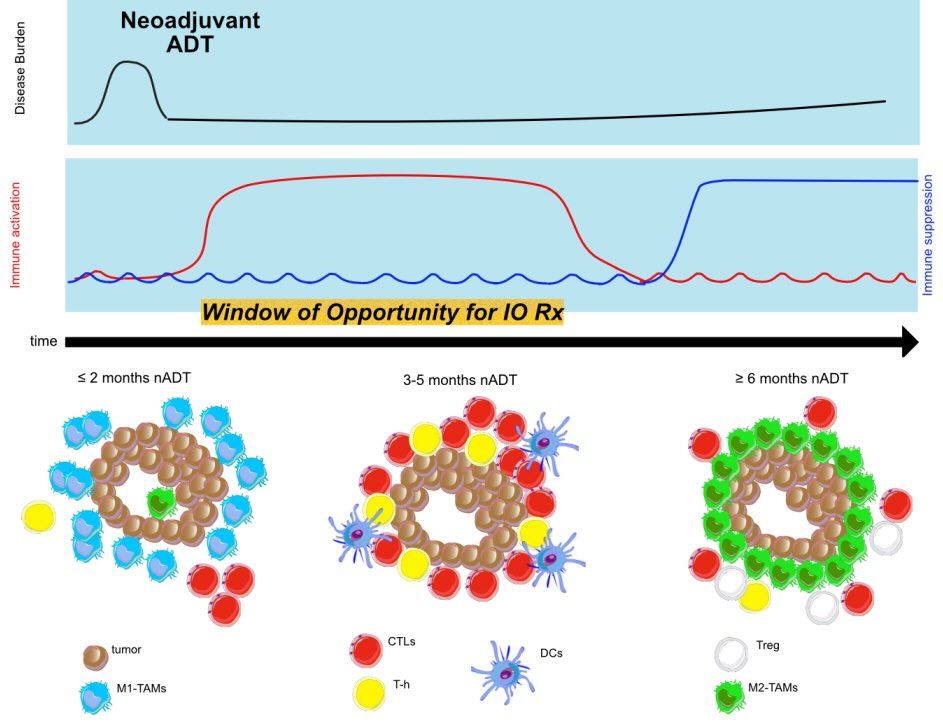
A multidisciplinary team of experts analyzed tumors from men who received ADT prior to prostate surgery. They found that immune and inflammatory pathways, particularly of antigen presentation and adaptive immune response, were increased within months of ADT, activating tumor-killing cytotoxic lymphocytes. While they observed a dramatic influx of activated immune cells within several months of ADT, after 6 months of ADT inhibitory immune cells were strikingly increased and cytotoxic lymphocytes decreased. The active immune cells clustered near tumor cells soon after ADT, but were replaced by the inhibitory immune cells in tumors after 6 months ADT.
“Our findings identify changes in the prostate tumor that explain established resistance to immunotherapies in patients already resistant to standard anti-androgen therapies,” says Dr. Nastiuk, Assistant Professor of Oncology in the Departments of Cancer Genomics and Urology. “We show here that ADT hormonal therapy rapidly activates the immune cells inside the prostate, opening up the possibility that tumors may respond to a combination approach — first treating aggressive tumors with ADT, and then instead of waiting for the cancer to progress, rapidly following up the ADT-activate tumors with immunotherapies to better treat prostate cancer.”

What is already known on this topic
Immune checkpoint inhibitors (known as ICIs or CPIs, checkpoint pathway inhibitors) have not been effective in treating most human prostate cancers. Advanced and recurrent prostate cancer patients are treated with androgen deprivation therapy (ADT), and although ADT is known to influence immune signaling, most evidence of ADT effects on prostate tumor derives from preclinical models, or single time-point clinical studies that capture static views of the immune landscape. Consequently, how immune–tumor interactions evolve during ADT remains unclear.
What this study adds
This study describes the temporal dynamics of the immune response of primary prostate cancers to ADT administered before prostate surgery (neoadjuvant ADT or nADT), thus revealing key information to develop a strategic approach to improve the efficacy of CPIs in prostate cancer. Renyuan Zhang, PhD, a recent Roswell Park doctoral graduate from Dr. Nastiuk’s laboratory and co-first author on the new study, discovered that after several months of nADT, inflammation and immune-related pathways were activated. This effect was accompanied by a robust influx of both CD8+ and CD4+ T cells into prostate tumors, suggesting activation of tumor-killing immune responses. In contrast, six or more months of nADT led to an immunosuppressive shift, with increased numbers of tumor-associated macrophages and regulatory T cells that can suppress the activity of cancer-killing T cells.
Translational relevance

“Our findings suggest a critical window of opportunity following neoadjuvant androgen deprivation therapy for initiating immune checkpoint inhibitors, and provide a rationale for the precise sequencing of hormonal and immune-based regimens to maximize therapeutic benefit,” notes study first co-author Anmbreen Jamroze, PhD, Research Assistant Professor of Oncology at Roswell Park working in the laboratory of Dean Tang, PhD, Chair of Pharmacology & Therapeutics. “These new data suggest that checkpoint inhibitors might be beneficial if used earlier during prostate cancer therapy progression, soon after ADT is initiated and prior to development of anti-androgen and immunotherapy-resistance.”
This investigation was supported by the National Cancer Institute, Department of Defense Prostate Cancer Research Program, the Prostate Cancer Foundation (PCF), institutional funds from the Roswell Park Alliance Foundation, and the National Cancer Institute Cancer Center Support to Roswell Park Comprehensive Cancer Center.
The work was supported by grants from the National Cancer Institute (project numbers R01CA260375, R01CA240290 and P30CA016056, Roswell Park’s Cancer Center Support Grant from the NCI), Department of Defense Prostate Cancer Research Program (award numbers W81XWH-19-1-0378, HT94252410120 and PC220273), Prostate Cancer Foundation (PCF) and Roswell Park Alliance Foundation.
###
From the world’s first chemotherapy research to the PSA prostate cancer biomarker, Roswell Park Comprehensive Cancer Center generates innovations that shape how cancer is detected, treated and prevented worldwide. The Roswell Park team of 4,000+ makes compassionate, patient-centered cancer care and services accessible across New York State and beyond. Rated “Exceptional” by the National Cancer Institute, Roswell Park, founded in 1898, was one of the first NCI-designated comprehensive cancer centers in the country and remains the only one in Upstate New York. To learn more about Roswell Park Comprehensive Cancer Center and the Roswell Park Care Network, visit www.roswellpark.org, call 1-800-ROSWELL (1-800-767-9355) or email ASKRoswell@RoswellPark.org.
Jane Rose, Media Relations Specialist
716-845-4919; jane.rose@roswellpark.org