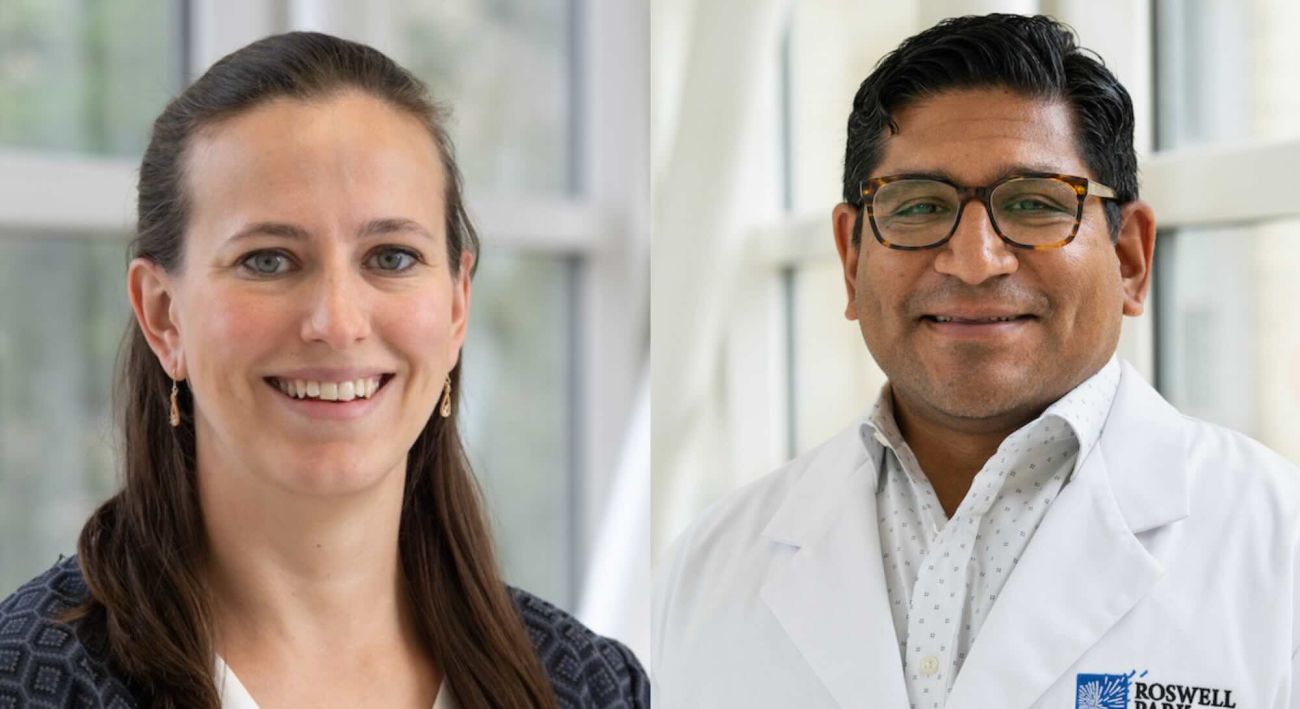
Headed by Roswell Park’s Dr. Marco Davila, research team zeroes in on tumor microenvironment
- Investigators identify factors linked to recurrence, refractory disease
- Shorter progression-free survival linked to macrophages
- Blocking CAR T cells’ secretion of interferon gamma could sustain responses
BUFFALO, N.Y. — Why do some patients experience disease resistance or recurrence after undergoing CAR T-cell therapy for the treatment of large B-cell lymphoma? A study led by hematology/oncology expert Marco Davila, MD, PhD, Senior Vice President and Associate Director for Translational Research at Roswell Park Comprehensive Cancer Center, sheds light on factors in the tumor microenvironment that contribute to resistance — and suggests ways to overcome them. Co-author Meredith Stone, PhD, Assistant Director for Cell Therapy Translation in Dr. Davila’s lab, will share the findings today in an oral presentation at the 67th annual meeting of the American Society of Hematology (ASH) in Orlando, Florida.
“These insights give us a good basis for strategies to enhance efficacy while reducing the toxic effects of treatment for our patients,” says Dr. Davila, who also holds the Rustum Family Endowed Chair in Translational Research at Roswell Park. “This is part of our larger body of work to develop ways to overcome immunosuppressive barriers and improve T-cell therapies for hematologic cancers.”
In collaboration with investigators from Moffitt Cancer Center, the team performed bulk RNA sequencing of tumor cells from 44 patients with large B-cell lymphoma (LBCL) prior to receiving the CAR T-cell therapy axicabtagene ciloleucel (Yescarta), which targets the CD19 protein found on most B-cell lymphoma cells. Researchers compared tumor characteristics of 18 patients whose remission lasted at least six months with those of 26 patients who relapsed earlier.
Key observations:
- Pre-treatment tumors in the shorter-remission group showed higher levels of tumor-associated macrophages, immune cells that can weaken anti-tumor responses. Enriched expression of M2-like macrophage-associated gene sets was associated with reduced CAR T-cell activity. Patients with high M2-like macrophages had a median progression-free survival (PFS) of 3.17 months compared with those with low levels whose median PFS had not yet been defined at 37 months.
- In laboratory models, macrophages cultured with CAR T and tumor cells showed a marked increase in inducible nitric oxide synthase (iNOS) expression (from 1.0% to 92.7%), which correlated with suppression of CAR T-cell function. This effect depended on CAR T cells’ secretion of interferon gamma (IFNγ). When IFNγ was blocked either through genetic modification during CAR T-cell culture or with an anti-IFNγ antibody, CAR T-cell activity improved in preclinical experiments.
The team concluded that blocking CAR T cells’ secretion of IFNγ to decrease iNOS in tumor-associated macrophages could extend responses to CAR T-cell therapy in patients with hematologic malignancies.
ASH 2025 Presentation Details
On Sunday, Dec. 7, 1:15-1:30 p.m. EST in Tangerine Ballroom F1, co-author Meredith Stone, PhD, in collaboration with senior author Marco Davila, MD, PhD, will present oral abstract 13711, CAR T cell-driven induction of iNOS in tumor-associated macrophages promotes CAR T-cell resistance in B-cell lymphoma.
###
From the world’s first chemotherapy research to the PSA prostate cancer biomarker, Roswell Park Comprehensive Cancer Center generates innovations that shape how cancer is detected, treated and prevented worldwide. The Roswell Park team of 4,000+ makes compassionate, patient-centered cancer care and services accessible across New York State and beyond. Rated “Exceptional” by the National Cancer Institute, Roswell Park, founded in 1898, was one of the first NCI-designated comprehensive cancer centers in the country and remains the only one in Upstate New York. To learn more about Roswell Park Comprehensive Cancer Center and the Roswell Park Care Network, visit www.roswellpark.org, call 1-800-ROSWELL (1-800-767-9355) or email ASKRoswell@RoswellPark.org.
Jane Rose, Media Relations Specialist
716-845-4919; jane.rose@roswellpark.org