Looking back on my 10 years of survivorship, I see the impact of cancer research in how different treatment is today
- Ovarian cancer treatment is far more personalized today than a decade ago
- Research and clinical trials have transformed patient care and quality of life
- Early detection remains a challenge, making continued research essential
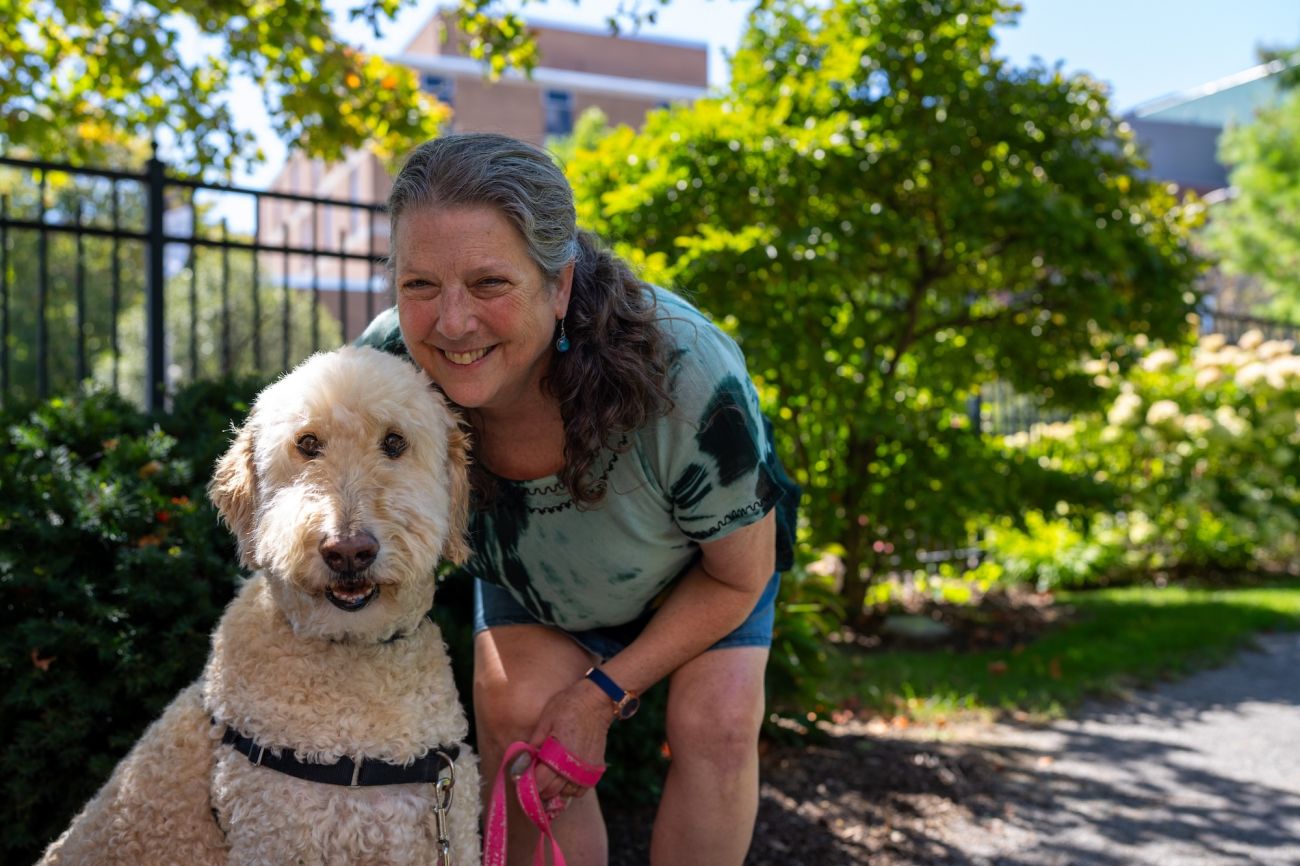
What a difference a decade makes. In 2015, at age 55, I was diagnosed with stage 2 ovarian cancer at Roswell Park Comprehensive Cancer Center. When I described my aggressive treatment to a friend, she shook her head and said, “Someday, we’ll look back and say, ‘We really used to do that to patients?’”
My friend was right.
As I compare my treatment in 2015 to the improved ovarian cancer treatments and services Roswell Park now offers, I realize more than ever the value of cancer research and clinical trials and the courage of those who participate in them. I also appreciate the comprehensive support for patients and their caregivers and the dedication of Roswell Park staff and patients who work together to improve outcomes for the future.
Early detection of ovarian cancer is still difficult
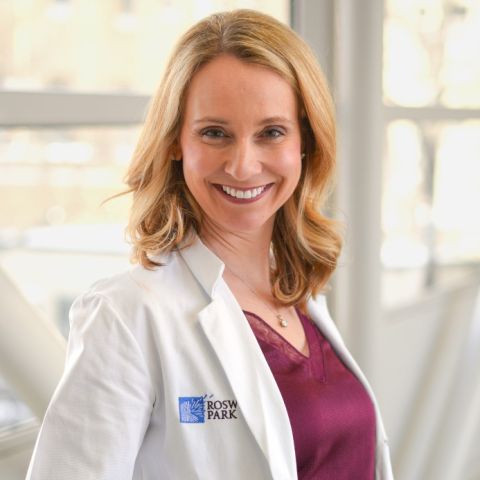
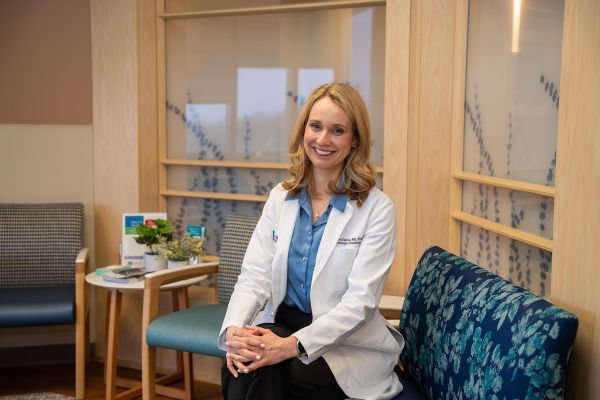
In 2015 there was – and still is – no reliable screening test for ovarian cancer. “Although there continues to be active research on this, there is still no screening test that is ready for clinical use,” says Emese Zsiros, MD, PhD, FACOG, and chair of Roswell Park’s Department of Gynecologic Oncology.
Due to vague and common symptoms, such as bloating, fatigue, non-specific abdominal pain and changes in bowel or bladder habits, early signs of ovarian cancer are often ignored, misdiagnosed or undiagnosed until the disease has progressed.
After months of feeling “off” with bloating and a mild abdominal pain, I was initially misdiagnosed with a hernia. When that was ruled out, I sought out my gynecologic provider. An ultrasound and MRI revealed a mass and fluid surrounding my right ovary, and two weeks later I underwent surgery at Roswell Park to remove the ovary and nearby lymph nodes. But mid-surgery, Roswell Park pathologists determined that the ovarian mass was malignant, so surgery was expanded to include removal of my uterus, fallopian tubes, both ovaries, and the omentum, the apron of tissue that covers the abdominal organs.
Why research matters: my treatment in 2015
After reviewing my case, my Roswell Park gynecologic oncologist recommended aggressive treatment that included 18 weeks of taxane-based chemotherapy delivered via an IV chest port, along with six mega-doses of platinum-based chemotherapy delivered directly into my abdomen every three weeks via an intraperitoneal (IP) port.
Roswell Park offered this highly specialized treatment. At the time, a clinical trial showed median overall survival was about 16 months longer when delivering the chemotherapy drugs through IP and IV ports, than just the IV treatment alone, but the regimen was difficult.
My doctor felt I was strong enough to get through it. While I could not complete my last three IV treatments due to severe allergic reactions, I made it through all six IP treatments and have not had any ovarian cancer recurrences. However, that combination of chemotherapy took a significant physical toll, with extreme fatigue, anemia and neuropathy that still plagues me. Today, this repeated IV/IP regimen is no longer routinely used.
“At the time, there was evidence of a survival benefit, but it was a very difficult regimen to tolerate. Later studies and newer treatment strategies changed practice, so we do not routinely use that approach today,” Dr. Zsiros explains.
A more personalized approach: tumor testing, tailored surgery, targeted therapy and HIPEC
When I was diagnosed in 2015, I had genetic testing to determine if a BRCA gene mutation may have contributed to my ovarian cancer. (It did not.) Today, all patients with epithelial ovarian cancer should be offered this germline genetic testing that identifies inherited genetic changes, in addition to tumor testing that identifies genetic changes acquired during life (not inherited) as well as other biomarkers. For many patients with advanced high-grade ovarian cancer, homologous recombination deficiency (HRD) testing of the tumor detects whether the tumor cells have specific weaknesses that make them vulnerable to certain types of treatments, guiding drug selection.
Treatment is now individualized from the start. Some patients who are fit and have disease that can likely be completely removed undergo cytoreductive, or debulking, surgery to remove all visible tumor followed by platinum-taxane chemotherapy. Others receive three to four cycles of platinum-taxane chemotherapy first, followed by debulking surgery if the cancer responds or remains stable, and then additional chemotherapy. A targeted therapy drug called bevacizumab may also be incorporated into chemotherapy and/or maintenance treatment for selected patients, with timing planned around surgery.
For some patients, hyperthermic intraperitoneal chemotherapy (HIPEC) may be offered during debulking surgery. In contrast to the repeated IP treatments I received, HIPEC is given once in the operating room, using heated chemotherapy circulated within the abdomen during surgery. It does not replace the systemic chemotherapy given before and after surgery.
“Randomized clinical trial data have shown that adding HIPEC during interval surgery can improve progression-free and overall survival in appropriately selected patients with stage 3 ovarian cancer,” Dr. Zsiros says. “It is an option for selected patients, not a treatment that every patient needs.”
Maintenance therapy and PARP inhibitors help delay recurrence
One of the biggest changes in ovarian cancer treatment over the last decade has been the introduction of maintenance therapy after initial treatment for selected patients, Dr. Zsiros explains. PARP inhibitors are targeted drugs that block PARP (short for poly ADP-ribose pomerase) which are enzymes involved in repairing damaged DNA, making it harder for some cancer cells to repair that damage.
“For patients with BRCA-mutated or HRD-positive advanced ovarian cancer, clinical trials have shown major improvements in progression-free survival with PARP inhibitor maintenance,” says Dr. Zsiros. “Depending on the tumor’s molecular features and the treatment already received, maintenance may include a PARP inhibitor, bevacizumab, or for selected HRD-positive patients, olaparib combined with bevacizumab. These treatments can delay recurrence or progression, but they do not guarantee that the cancer will not return. Genetic and tumor testing now help us choose maintenance treatment much more precisely than we could a decade ago.”
Improvements in post-surgical pain management
In 2015, I was sent home post-surgery with a prescription for 40 opioid pain pills – enough to get me through several weeks, and far more than I ultimately needed. I was afraid of these pills, so after taking only two I was able to manage my pain with extra-strength acetaminophen.
A few years later, Dr. Zsiros led a study showing that postoperative pain can often be managed with far fewer opioids. Roswell Park implemented an opioid-sparing protocol that limited routine discharge prescriptions and emphasized non-opioid pain medicines whenever appropriate. The program resulted in a 45% decrease in the volume of opioids prescribed and a 14% decrease in refill requests, without compromising patient-reported pain control, and has since become standard practice at Roswell Park.
Exercise during and after treatment: A new clinical trial close to my heart
I have been running or walking daily since I was 15 – including most days during my cancer treatment, albeit at a much slower pace and shorter distance. (There was one day during treatment, however, that I could barely finish my route, now nicknamed “anemia hill.”) I believe that knowing my body helped me discover my cancer at an early stage and that daily exercise helped me physically and emotionally endure a really tough treatment program.
I am excited that Dr. Zsiros has initiated the “Life on the Go 3” clinical trial, in which patients with ovarian and endometrial cancer wear Fitbit and continuous glucose-monitoring devices. The study tests whether a personalized physical activity program can help more patients reach recommended activity levels, while also evaluating quality of life, physical function and metabolic and immune measures and exploring longer-term benefits.
Several ongoing studies at Roswell Park offer additional approaches for women with ovarian cancer, such cellular therapies and next-generation antibody-drug conjugates.
Clinical trials at Roswell Park
Learn about today’s clinical trial options at Roswell Park to fight ovarian cancer.
What hasn’t changed over the last 10 years
While many things in ovarian cancer treatment have changed over the last decade, for me, some things remain constant. This includes my gratitude for all who help to improve cancer treatments through research and participation in clinical trials, those who raise funds for cancer research and programs at Roswell Park, and for the exceptional care and compassion I’ve received from so many Roswell Park employees. I am also forever grateful for my amazing Roswell Park gynecologic-oncologists, PAs and many other doctors, patients and support staff I’ve interacted with over the last decade.
Through my own experience with these wonderful people, I have learned that research matters and provides hope that many more cancer patients will become survivors and someday cancer will be a thing of the past.
Editor’s Note: Cancer patient outcomes and experiences may vary, even for those with the same type of cancer. An individual patient’s story should not be used as a prediction of how another patient will respond to treatment. Roswell Park is transparent about the survival rates of our patients as compared to national standards, and provides this information, when available, within the cancer type sections of this website.