- Minimally invasive precision treatment
- Reduced side effects
- Quick recovery and outpatient procedure
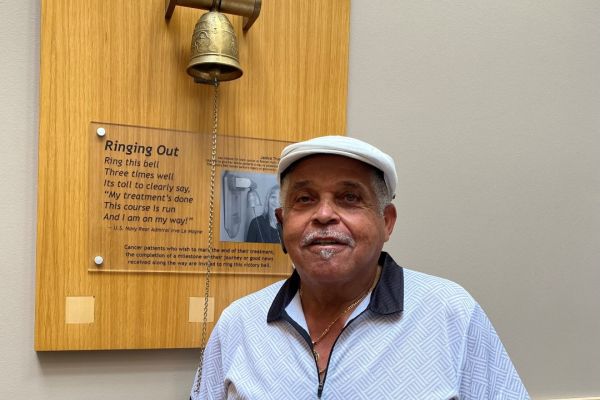
When Lockport native Chuck Blackley learned he had prostate cancer in February 2024, his diagnosing provider gave him options for treatment.
“They told me that I could have surgery, I could have radiation. I could just wait and see, which I didn’t think was a good idea,” he says. But after waiting for hours to be seen, the urologist and the radiologist weren’t on the same page about how to best to proceed with his treatment — which didn’t sit well with the retired Navy and National Guard veteran.
“One was recommending one thing, one was recommending another,” Chuck recalls. "That’s when I decided I wanted another opinion and that’s when I chose Roswell and I’m glad I did.”
At Roswell Park Comprehensive Cancer Center, Chuck met with urologist Ahmed Aly, MD and his team, who also talked with him about surgery, radiation and a few other options for treating his prostate cancer, including a new therapy called High-Intensity Focused Ultrasound, or HIFU.
The option for HIFU treatment, he says, sounded better to him than anything else. Roswell Park is the only provider in the Buffalo region to offer HIFU therapy for prostate cancer treatment. “They walked through every step of what was going to happen, how it worked. I mean, every detail was explained to me,” says Chuck. “I really liked Dr. Aly.”
How HIFU can be an effective treatment for prostate cancer
High-Intensity Focused Ultrasound offers a safe, nonsurgical way to treat prostate cancer that allows patients to go home the same day. It’s a type of “focal” therapy that treats only the part of the prostate gland that has cancer, rather than removing the entire gland. This allows for precise treatment of the affected part of the prostate without damaging healthy tissues and nerves.
"It's less invasive compared to surgery or radiation which allows for recovery much faster for patients. Patients are under general anesthesia, so pain is not a significant issue with significantly lower anesthetic risks and side effects, including urinary and sexual side effects," Dr. Aly explains.
Compared to surgery or radiation, the risk for incontinence or erectile dysfunction with HIFU is far less. “I know a lot of guys that have their prostate removed and they’re not happy campers. A guy I served with at the National Guard went to the VA for his treatment and is still having problems. Another guy I talk with had surgery and he’s still having issues,” Chuck shares. “I’m glad I did what I did.”
How does HIFU work?
HIFU uses ultrasonic waves, sound waves at a high frequency, generated by a transducer to kill cancer cells in the prostate. The sound waves target the affected area and rapidly heat up the cancer cells to kill them without damaging healthy tissue or other areas around the cancer.
The prostate is first scanned using an ultrasound probe that allows for planning and targeting the cancer cells precisely, leaving the healthy tissue unharmed.
Who is eligible for HIFU?
Chuck’s team determined he was a suitable candidate for HIFU treatment, which is recommended for people with early-stage prostate cancer that has not spread beyond the prostate, and for patients with low- to moderate-risk disease.
"Ideal candidates for HIFU are patients with low or intermediate risk or early-stage prostate cancer that has not spread beyond the prostate. Other criteria include the grade of the tumor, the location and whether it is visible on imaging or not. Patients with prostate cancers on active surveillance that has started to show signs of progressing, and who want to consider an alternative to surgery or radiation may also be viable candidates for HIFU treatment," Dr. Aly says.
"If the cancer returns in the untreated area, what we call 'out-of-field,' or even in a previously treated area, HIFU can be used again. It can even by used as salvage therapy in select men who failed prior radiation treatment."
The length of a HIFU procedure depends on the size of the area to be treated, and generally lasts about two hours, with about 45 minutes of recovery time before going home.
"Nevertheless, no procedure is complication-free," Dr. Aly adds. "Complications might occur with HIFU, but the risk of developing them is significantly lower when compared to surgery and radiation."
All HIFU patients require a catheter after the procedure for a few days because the prostate swells initially due to inflammation before it starts to shrink.
“It’s a one-day process, you’re in and out,” Chuck says of his HIFU experience at Roswell Park, adding that he experienced only minor pain from the post-procedure catheter that’s removed at the follow-up appointment about a week later.
“They took the catheter out and then six months after that they scheduled bloodwork and an MRI which showed that there was no cancer there. A few weeks ago, I had another biopsy and everything was completely clean.”
Need a second opinion?
If you have a suspicion or diagnosis of prostate cancer, you need a second opinion. We will ensure you get it without delay.
Why Roswell Park for prostate cancer
When asked what he wants people with prostate cancer to know most about his HIFU experience, Chuck refers to Roswell Park’s iconic invitation to “spend one day with us.”
“Spend the day with Roswell and then listen to them. Sit down with them and hear them out. That’s the best advice I can give,” he says. “I got to make the decisions that I feel comfortable with. I don’t like surprises and I really didn’t have any surprises at Roswell.”
Spending just one day in Buffalo for a second opinion at Roswell Park could mean clarity or even a change in your diagnosis, more treatment options personalized to your cancer and individual needs, and most importantly, more hope.
In addition to renowned urologists with special expertise in oncology, our multidisciplinary team includes radiologists, medical oncologists and pathologists who focus only on cancer. As a comprehensive cancer center designated by the National Cancer Institute, Roswell Park can offer access to emerging drugs, new technologies and clinical trials not available elsewhere.
“We have a dedicated team that only focuses on prostate cancer,” Dr. Aly says. “We believe in patient-centered care, we put patients always first. At Roswell Park, we offer patients a multidisciplinary approach with our robust active surveillance program and world-class robot-assisted surgeons, as well as cutting-edge technologies."
Editor’s Note: Cancer patient outcomes and experiences may vary, even for those with the same type of cancer. An individual patient’s story should not be used as a prediction of how another patient will respond to treatment. Roswell Park is transparent about the survival rates of our patients as compared to national standards, and provides this information, when available, within the cancer type sections of this website.