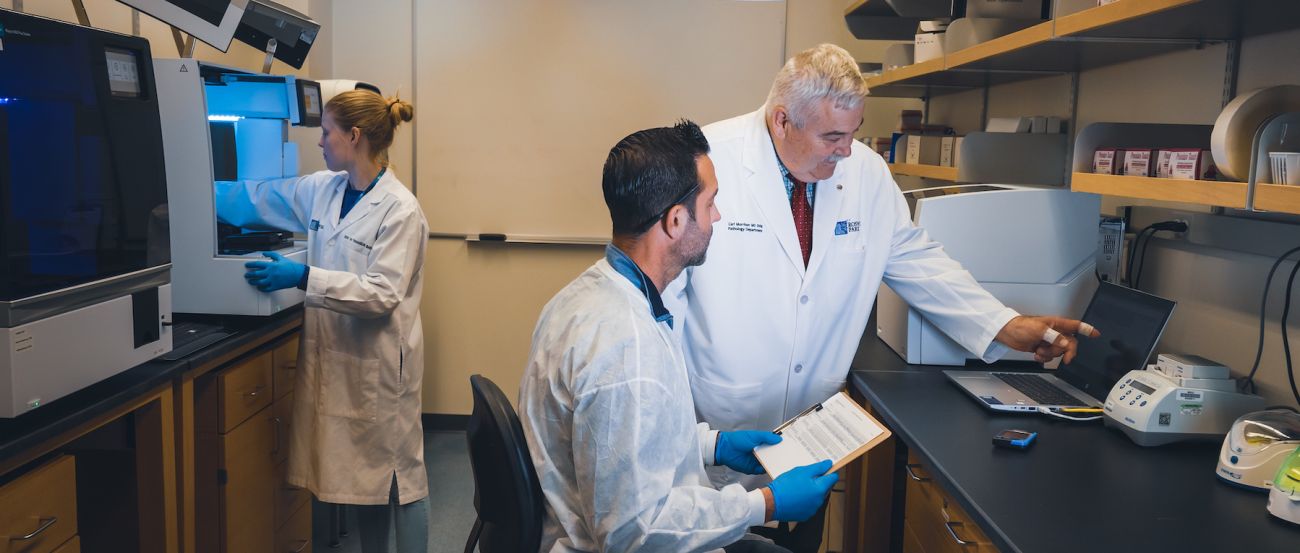
A bold idea about a simple blood test is now advancing to phase II studies following promising results in early stage research, funded by donations. The Roswell Park Liquid Biopsy, developed by Roswell Park’s Department of Pathology, has the power to detect trace amounts of cancer in blood.
This has two exciting applications: monitoring how a patient is responding to therapy and determining if a patient’s cancer has returned. Phase II starts early this year and will focus on recurrence monitoring before moving into response to therapy in phase III. The advancement of this exciting new test has been three years in the making — and made possible by generous donors like you.
Carl Morrison, MD, DVM, and his team are leading the development of this innovative method. As Senior Vice President of Scientific Development and Integrative Medicine and Chair Emeritus of the Department of Pathology & Laboratory Medicine, Dr. Morrison is committed to bringing the most advanced and effective care to Roswell Park patients. We believe the Roswell Park Liquid Biopsy is the innovative, convenient and cost-effective solution we’ve been waiting for.
What Is the Roswell Park Liquid Biopsy?
The Roswell Park Liquid Biopsy is a routine blood test that, when combined with Roswell Park’s novel, ultrasensitive technology, has the potential to revolutionize the future of cancer care for virtually all patients.
It works like this: Cancer cells secrete mutated DNA that can be measured in a patient’s blood to indicate whether the amount of cancer in their body is changing. Existing methods are 60-80% accurate. Our test uses proprietary technology that offers three to five times more accuracy than other methods, delivering data with 95% accuracy.
Because healthy cell DNA vastly outnumbers cancer cell DNA in the blood, this new technology is critical to provide reliable results for effective, dynamic monitoring of a patient’s cancer. If a patient’s blood is tested after each treatment, their doctor can determine in real time if the cancer is increasing, decreasing or staying the same. After surgery, the test can help determine if there is still cancer in the patient’s body. Patients wouldn’t have to wait months for an MRI or CT scan to see how treatment is progressing; they could monitor the disease visit by visit.
Dr. Morrison explained that this has massive implications, not only for the way we diagnose and treat cancer, but for a patient’s quality of life.
“Imagine if you’re claustrophobic and can avoid ever having to go into a CT scanner again … if you can detect your relapse or your recurrence earlier … if you can do it more conveniently. That has extreme value. And that's the way life will be in another five or 10 years,” he said.
Phase I Findings
Phase I, made possible by donations from the Alliance Foundation, included:
1. A technical validation of the liquid biopsy
2. Collection of samples for an observational, non-interventional study that looked at patients whose early-stage cancer was removed by surgery. Blood samples, collected 1 to 3 months after surgery, will be used in Phase II for recurrence monitoring.
3. Collection of samples for a study in cancer patients with advanced disease who are treated every two to three weeks with chemotherapy, immunotherapy or a combination treatment. Phase III will look for increasing, decreasing or plateaued levels of cell-free DNA to monitor response to therapy in real time.
Dr. Morrison and his team enrolled more than 1,600 people, exceeding their original 1,000-person goal. Phase 1, known as the “technical” development phase, showed incredible promise.
Bailey Stark, project manager for the study, explained that some samples still need time to mature. “We're collecting samples before people have surgery and after they've had surgery at specific intervals,” she said, “Then you have to wait five years to know if they’ve they had a recurrence or not. We're three years in.”
Phase II is critical in the development of this method, and Dr. Morrison’s team is up for the challenge.
The Future of the Roswell Park Liquid Biopsy
The next phase will last approximately six months. Beyond this, the team anticipates a year and a half to prove their technology and another few years for the Roswell Park Liquid Biopsy to become a standard of care. This is a fast paced and aggressive path toward higher quality cancer care, a path that would not be possible without your support.
“If you don't have money from sources like the Alliance Foundation to move you from a patent to a pre-early stage of commercialization, innovation won't happen. So, donor funding is critical. It's the foundation of innovation at Roswell Park,” Dr. Morrison explained. “If you want to impact patient care, invest in innovation.”
Your donations are exactly that: an investment in innovation. Together, we’re revolutionizing the future of cancer care!