Roswell Park’s maxillofacial rehabilitation services help to restore appearance and function
- 3-D technology helps patients look and feel like themselves after surgery.
- Dr. Frias creates lifelike replacement ears and noses.
- Replacement body parts are 3D-printed and created using biocompatible material.
Innovative 3-dimensional digital technology available at Roswell Park Comprehensive Cancer Center is helping patients look and feel more like themselves after surgical treatment that has significantly changed their appearance.
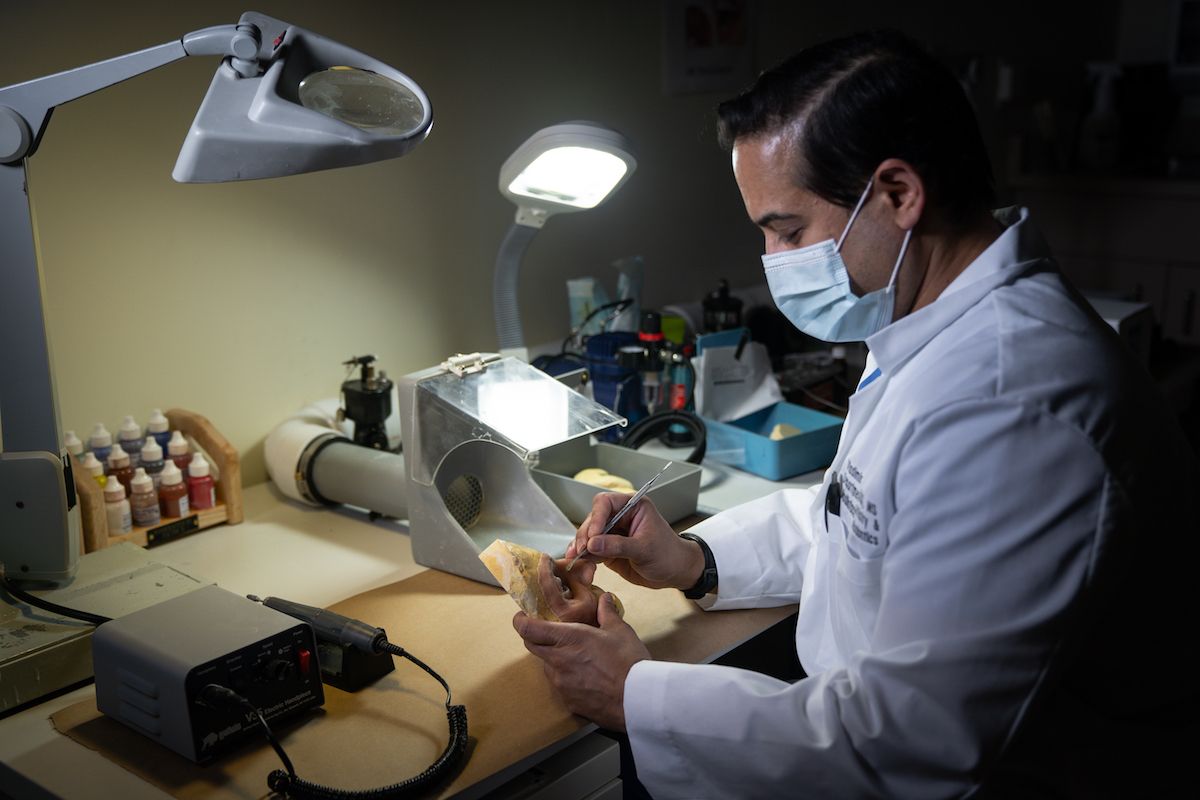
“A lot of work that used to be handmade is now done digitally,” explains Vladimir Frias, DDS, MS, FACP. As Director of Maxillofacial Prosthetics at Roswell Park, he creates lifelike prostheses — artificial substitutes for missing parts to restore a patient’s pre-surgery appearance and recover lost functions.
For some patients with cancers of the head or neck, surgical treatment can sometimes result in the loss of an ear, a nose, an eye or other body part. Removal of structures such as the hard palate (roof of the mouth) can make it difficult or impossible to chew, swallow or speak. These physical changes often lead to emotional distress that can compromise your optimal recovery.
Roswell Park is home to one of only a few maxillofacial rehabilitation centers in the state, where surgeons, radiation oncologists and prosthetic specialists work together on treatment planning. Roswell Park offers services to replace any part of the jaws, and other parts of the head and neck, including eyes, ears and noses.
“In addition to 3D photography and laser scanning, Roswell Park’s Diagnostic Radiology Department can now use a 3D printer to create patients’ anatomical models based on data from CT scans instead of traditional physical impressions,” Dr. Frias says. Before the new imaging technology, photos and silicon were used to make impressions of the area where the prosthetic was to replace an affected area. “Using laser scanning or 3D imaging is more precise. It saves treatment time and is much more comfortable for the patient.”
Using the latest 3D imaging and printing to create facial prostheses
Roswell Park’s capabilities with 3D imaging and printing have revolutionized the process. Before surgery, Larson Hsu, MD, director of Roswell Park’s 3D Imaging Lab, collaborates with Dr. Frias to make sure each prosthesis will match a patient’s pre-surgery appearance. Dr. Hsu turns the data from your CT/MRI images into physical models that can be manipulated on a computer screen.
“The state-of-the-art lab uses 3-dimensional patient models to digitally design and fit individualized medical devices,” explains Dr. Hsu. “Wearable devices can be fabricated later using biocompatible materials and may include a prosthetic ear or nose that can be surgically attached to replace a body part damaged by cancer treatment.”
Restoring a person’s appearance helps to restore their life
How is the prosthesis held in place? For some patients, magnets or clips embedded in the prosthesis connect to titanium implants placed in the bone during surgery. For others, the prosthesis is screwed directly into the implants with titanium screws. For patients who are unable to receive stock implants, custom implants are digitally designed to fit anatomical structures more precisely.
Implants are possible only when the bone is healthy and strong and has not been weakened by radiation to the head and neck. To make this an option for as many patients as possible, Dr. Frias works closely with radiation oncologists to ensure that your bones are protected by using radiation shields custom made for your face.
If you are a candidate for implants, Dr. Frias joins the surgical team in the operating room and installs the screws into the bone during surgery. In other cases, implant surgery may be delayed until you have healed from the surgery to remove the cancer. For jaw removal, Dr. Frias can wire or screw a surgical prosthesis in place until healing is complete.
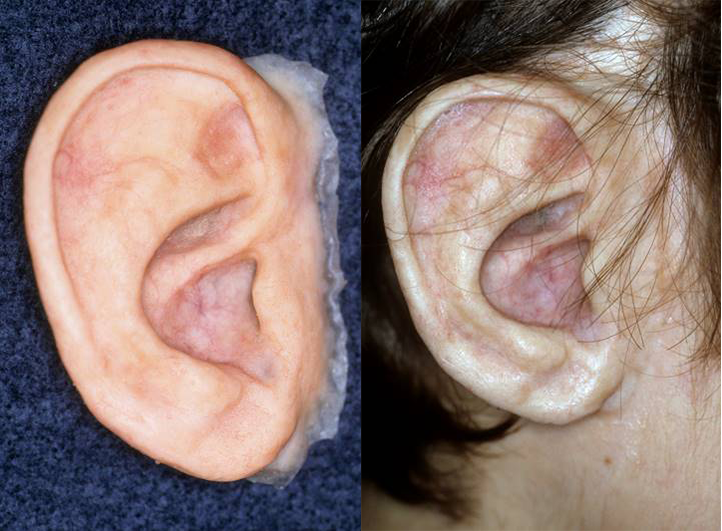
Most prostheses have a titanium or acrylic base with a silicone surface that can be matched to your own skin color, so it looks realistic, natural and blends in perfectly with the surrounding skin.
“We do everything, start to finish, in our lab. It’s a lot of fun to do,” Dr. Frias says. “And I think it’s a great way to help people.”
Often when patients first see themselves with the new prosthesis in place, they burst into tears, he confides.
“Some of the best reactions come from the rest of their family members, because we’ve made the patients look completely natural, and in some cases they haven’t seen their loved one look like that in years.” he says. “It’s the most rewarding feeling I’ve ever had.”
Plastic & reconstructive surgery at Roswell Park
Our surgeons use advanced microsurgery techniques to repair and restore tissue and structures, transfer skin, fat, muscle, and other tissue, and reestablish blood flow and nerve function to repaired areas.