Bladder Cancer Staging

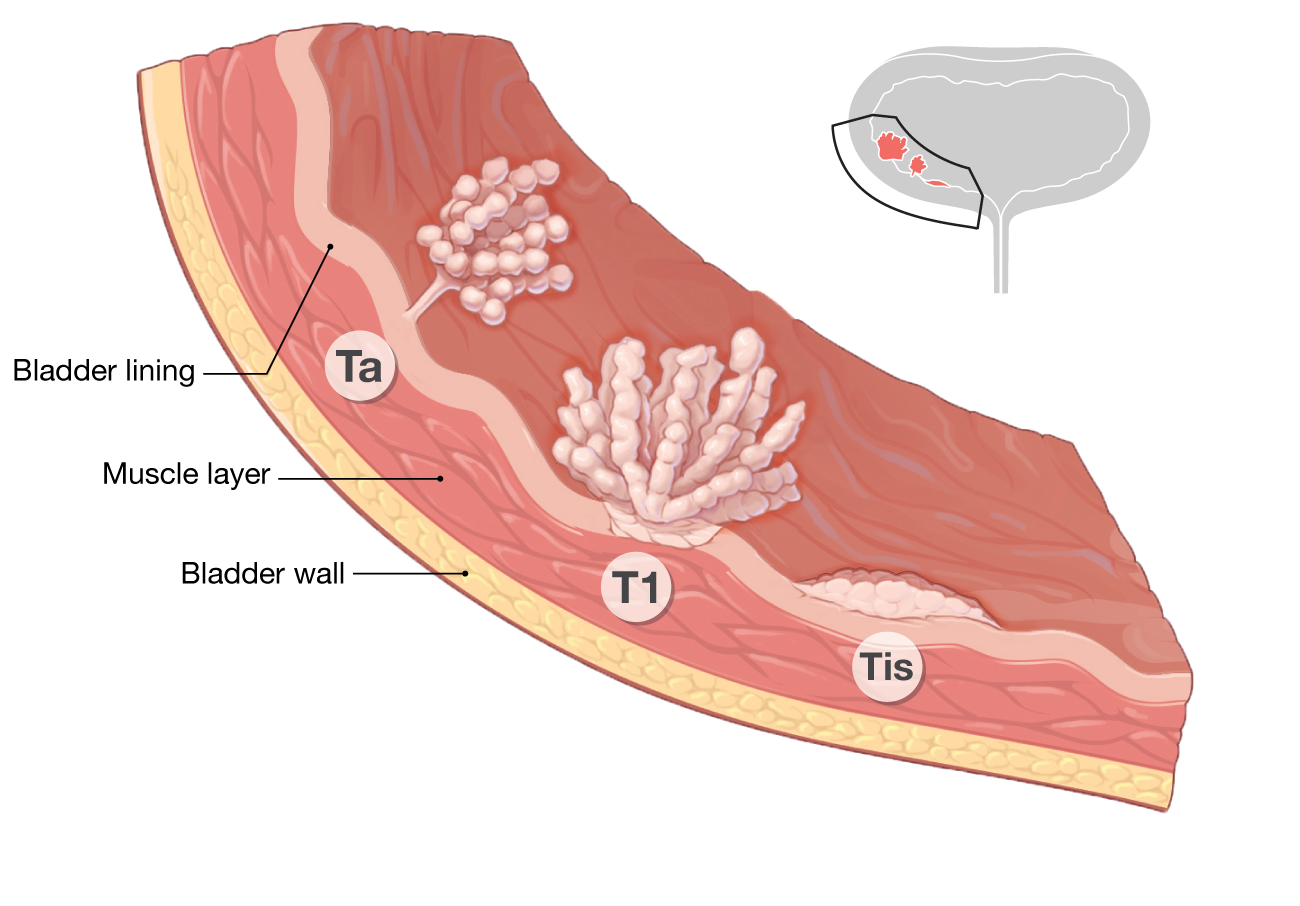
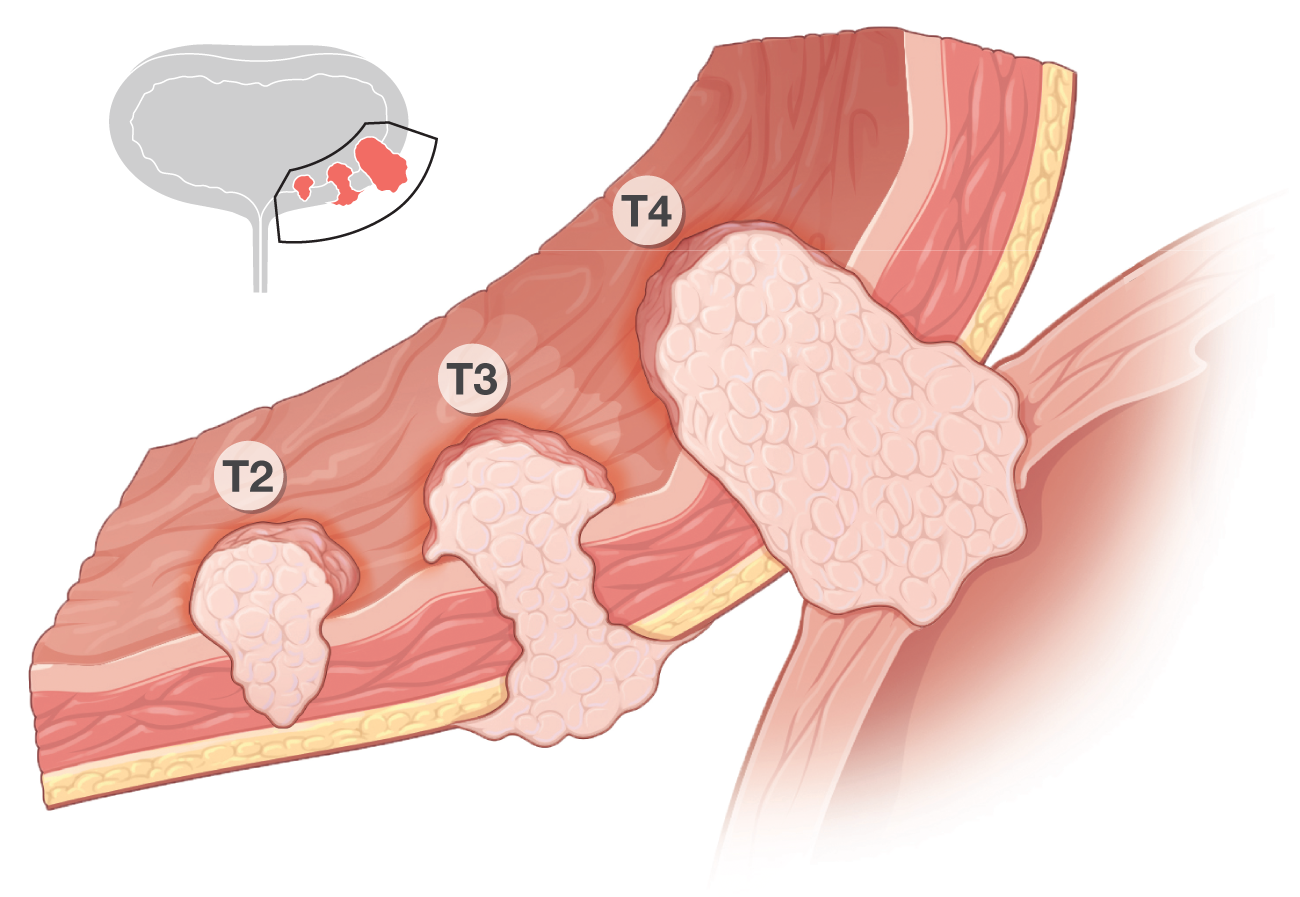
Staging classifies the extent of cancer. The number indicates how deeply the tumor has invaded the bladder and/or spread beyond the bladder. The American Joint Committee on Cancer (AJCC) uses the TNM classification to define the stages of bladder cancer:

T is for Tumor.

The number after the T indicates the size of the tumor and how far it has invaded. The larger the number, the bigger and/or more invasive the cancer.

  • TX is that a primary tumor cannot be assessed.
  • T0 is no evidence of primary tumor.
  • Ta is noninvasive papillary carcinoma.
  • Tis is carcinoma in situ or “flat tumor”
  • T1 is that tumor invades subepithelial connective tissue.
  • T2 (both T2a and T2b) has invaded the muscle.
  • T3 (both T3a and T3b) has invaded into the fat surrounding the bladder.
  • T4 (both T4a and T4b) has invaded 1 or more of the following: prostate, seminal vesicles, uterus, vagina, pelvic wall or abdominal wall.

N is for Nodes.

The number after the N indicates whether the cancer has spread to the lymph nodes.

  • Nx means the regional lymph nodes cannot be assessed.
  • N0 means there is no metastasis (spread) of the cancer to the local nodes.
  • N1 means there has been metastasis to a single regional lymph node in the true pelvis. 
  • N2 means there is metastasis in multiple regional lymph nodes in the true pelvis. 
  • N3 means there has been metastasis to the common iliac lymph nodes.

M is for Metastasis.

The number after the M indicates whether the cancer has spread to distant areas of the body.

  • M0 means there is no distant metastasis.
  • M1 means the cancer has metastasized to at least 1 site.

Another system for identifying the stages of bladder cancer uses roman numerals from I to IV to define the extent of the disease. The definitions of these stages are as follows:

  • Stage 0: cancer cells are found only on the surface of the inner lining of the bladder. It can also be referred to as “superficial cancer” or “carcinoma in situ”. Though most of these cancers do recur, only 5% will become the type of cancer that invades the muscle tissue of the bladder.
  • Stage I: cancer cells are found below the top layer of the bladder's inner lining. They have not spread to the muscle of the bladder.
  • Stage II: cancer cells have spread to the muscle of the bladder.
  • Stage III: cancer cells have spread through the muscle layers of the bladder to the layer of tissue surrounding the bladder. Tumor invades any of the following: the prostate in the male, the uterus and/or vagina in the female. Cancer that invades the muscle tissue is life-threatening and requires aggressive treatment.
  • Stage IV: cancer extends to the wall of the abdomen or to the wall of the pelvis. Cancer cells may have spread to lymph nodes and other parts of the body away from the bladder.

Combinations of the above are used to determine the prognosis and make treatment decisions. Treatment is decided by stage and grade.

Grades of Bladder Cancer

To help predict how fast cancer will grow and spread, the doctor will want to know its grade. Cancer is graded by looking at cancer cells under a microscope. Uneven cells that are multiplying receive the highest grade.

  • Low Grade: cells given this grade appear fairly normal. Some cells may have increased in size. Some are multiplying.
  • High Grade: high grade cells are very uneven in shape. They vary widely in size and all are multiplying.

Cancer Talk Blog

May is National Brain Tumor Awareness Month. To help you begin to understand this complex group of tumors, we have compiled some of the key facts, statistics and information below. Learn about the Neuro-oncology Center at Roswell Park or consult the links and sources below for more information. Brain Tumor Facts and Figures

Ask A Question

Do you have a cancer question you’d like RPCI cancer experts to address? Submit a topic for consideration.

close