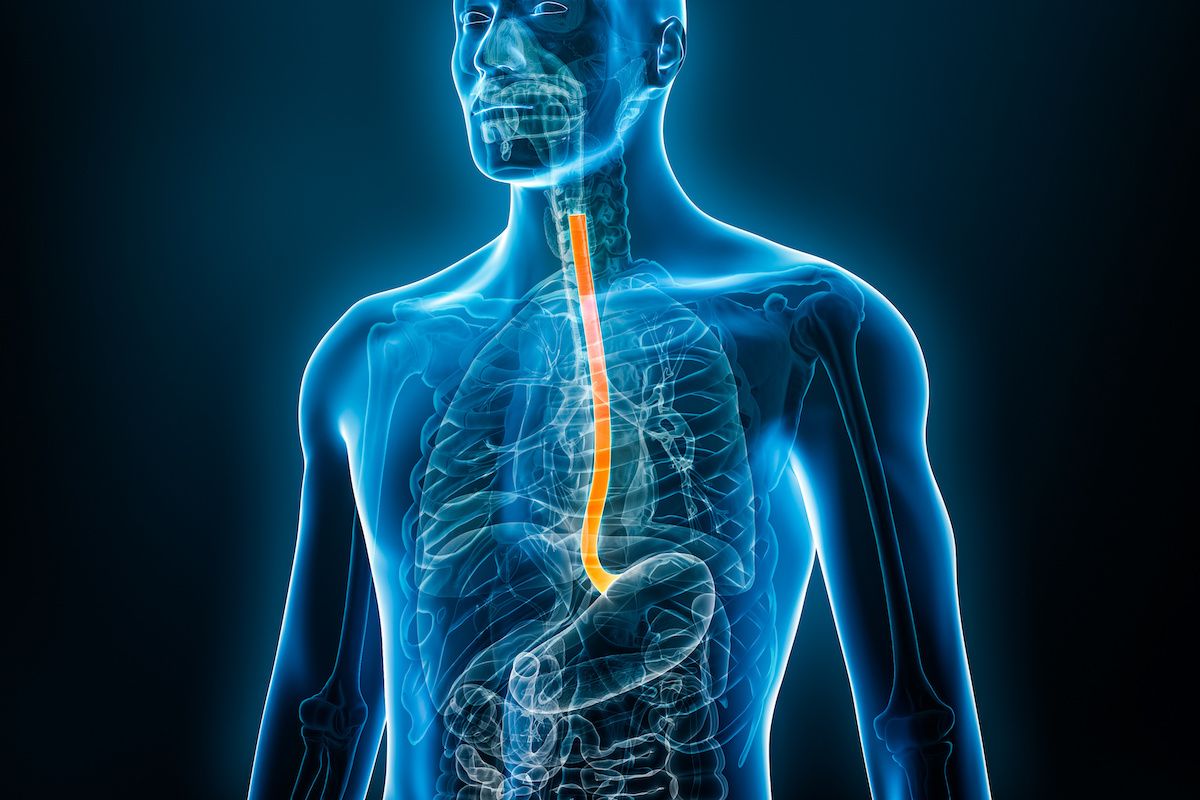
Acid reflux occurs when stomach acid leaks back up into the esophagus, causing heartburn, indigestion and other discomfort. Eating a large meal or acidic foods and drinks are things that may cause irritation during the digestion process, and while acid reflux can be common, is there a point at which you should become worried about it?
When acid reflux becomes chronic, the name for this condition is gastroesophageal reflux disease, or GERD. Ongoing GERD requires treatment and may begin to cause damage to the esophagus lining, leading to a condition called Barrett’s esophagus.
Risk factors for Barrett’s esophagus
“Barrett’s esophagus is a condition that occurs in some people as a response to chronic reflux,” says gastroenterologist Kevin Robillard, MD, FASGE, an Associate Professor of Oncology in the Department of Internal Medicine at Roswell Park Comprehensive Cancer Center. “The stomach lining handles acid reflux quite well, but the esophagus is not well suited to deal with that acid. In response to excessive reflux, the esophagus might change its lining, and the name for that change is Barrett’s esophagus.”
While GERD is the strongest contributor for developing Barrett’s esophagus, there are additional traits that make a person more at risk for developing the disease, such as:
- White race
- Assigned male at birth
- Age over 50
- Smoking
- Obesity (particularly central obesity)
- A family history of Barrett’s esophagus or esophageal cancer.
Since Barrett’s esophagus is relatively asymptomatic, many patients may not realize they have this condition. Typically, people learn that they have Barrett’s esophagus when they undergo an endoscopy for reasons such as reflux, problems with swallowing, chest discomfort or abdominal pain.
If Barrett’s is suspected during an endoscopy, a biopsy is taken of the esophageal lining during the procedure to verify the presence of the condition.
Is Barrett's esophagus a cancer?
Barrett’s esophagus is considered a precancerous condition, however the majority of people with the condition do not develop cancer. On average, for every 1000 people who have Barrett’s esophagus, only three to five of them will be diagnosed with cancer.
The key determinant is whether there is dysplasia (abnormal cells), a sign of advanced stage Barrett’s. For people with high-grade dysplasia, meaning dysplasia that is very close to (but not quite) cancer, the chance of developing cancer increases dramatically, up to 15 to 20%. “If a patient shows signs of either low-grade or high-grade dysplasia, we’ll typically perform treatment to eradicate the Barrett’s condition. We know that those individuals are at a higher risk for developing cancer than the average patient with Barrett’s and available treatments work very well to reduce this risk.”
Why Roswell Park?
If you are diagnosed with a precancerous condition, it's important to be monitored in a center where the experts are.
Can Barrett’s esophagus be reversed?
Yes, says Dr. Robillard. “Barrett’s esophagus can often be treated to the point of eradication, which would reverse it all together. Similarly, medications can prevent it from progressing any further towards cancer.” Surveillance endoscopies are also performed regularly to assess the evolution of the Barrett’s — typically every three to five years after initial diagnosis.
Treatment and management of Barrett’s esophagus is proven to be effective in two different ways:
- Medications called proton pump inhibitors
- Ablation procedures, specifically Radiofrequency Ablation (RFA)
“The first line management of Barrett’s esophagus is through proton pump inhibitors,” says Dr. Robillard. “These are acid-reducing medications meant to decrease the damage of acid reflux and, as a result, decrease the rate at which Barrett’s esophagus converts to cancer.”
Radiofrequency Ablation (RFA) is an endoscopic procedure that uses thermal energy. Focused heat is applied to the lining of the esophagus where Barrett’s is present. The lining that has been subjected to the heat will eventually shed and be replaced by tissue that is not precancerous. In some situations where Barrett’s has progressed to early cancer, there are still minimally invasive treatment options available via endoscopy. “We’re able to remove the cancer via the endoscope without surgery or chemotherapy, this provides a curative treatment with the scope alone,” says Dr. Robillard.
It is for this reason that it is important to seek out expertise at a center that has the experience and volume of treatment for your disease. “There is overwhelming data and guidelines supporting the idea that if you have advanced Barrett’s esophagus, you should go to a center of excellence where there are multiple specialists involved in your care,” says Dr. Robillard.
Because of this expertise — and a care team that includes both a surgical oncologist and an endoscopic oncologist — your treatment plan will be customized to your unique disease.
"The rate of esophageal cancer is increasing in the US but our weapons against this cancer continue to increase. There are now multiple endoscopic approaches to prevent and treat advanced Barrett’s Esophagus and early esophageal cancer. Often cancer can be prevented, and tumors can be removed without surgery," Dr. Robillard says "In individuals who could potentially have a surgery where part of their esophagus is removed, we may be able to save them from this surgery and perform an organ-sparing intervention.”