About Uterine Cancer

Cancer is a group of many related diseases. All cancers begin in cells, the body's basic unit of life. Cells make up tissues, and tissues make up the organs of the body.

Normally, cells grow and divide to form new cells as the body needs them. When cells grow old and die, new cells take their place.

Sometimes this orderly process goes wrong. New cells form when the body does not need them, and old cells do not die when they should. These extra cells can form a mass of tissue called a growth or tumor.

Tumors can be benign or malignant:

  • Benign tumors are not cancer. Usually, doctors can remove them. Cells from benign tumors do not spread to other parts of the body. In most cases, benign tumors do not come back after they are removed. Most important, benign tumors are rarely a threat to life.

Benign Conditions of the Uterus

  • Fibroids are common benign tumors that grow in the muscle of the uterus. They occur mainly in women in their forties. Women may have many fibroids at the same time. Fibroids do not develop into cancer. As a woman reaches menopause, fibroids are likely to become smaller, and sometimes they disappear. Usually, fibroids cause no symptoms and need no treatment. But depending on their size and location, fibroids can cause bleeding, vaginal discharge, and frequent urination. Women with these symptoms should see a doctor. If fibroids cause heavy bleeding, or if they press against nearby organs and cause pain, the doctor may suggest surgery or other treatment.
  • Endometriosis is another benign condition that affects the uterus. It is most common in women in their thirties and forties, especially in women who have never been pregnant. It occurs when endometrial tissue begins to grow on the outside of the uterus and on nearby organs. This condition may cause painful menstrual periods, abnormal vaginal bleeding, and sometimes loss of fertility (ability to get pregnant), but it does not cause cancer. Women with endometriosis may be treated with hormones or surgery.
  • Endometrial hyperplasia is an increase in the number of cells in the lining of the uterus. It is not cancer. Sometimes it develops into cancer. Heavy menstrual periods, bleeding between periods, and bleeding after menopause are common symptoms of hyperplasia. It is most common after age 40.
  • To prevent endometrial hyperplasia from developing into cancer, the doctor may recommend surgery to remove the uterus (hysterectomy) or treatment with hormones (progesterone) and regular followup exams.

Malignant tumors are cancer. They are generally more serious and may be life threatening. Cancer cells can invade and damage nearby tissues and organs. Also, cancer cells can break away from a malignant tumor and enter the bloodstream or lymphatic system. That is how cancer cells spread from the original (primary) tumor to form new tumors in other organs. The spread of cancer is called metastasis.

When uterine cancer spreads (metastasizes) outside the uterus, cancer cells are often found in nearby lymph nodes, nerves, or blood vessels. If the cancer has reached the lymph nodes, cancer cells may have spread to other lymph nodes and other organs, such as the lungs, liver, and bones.

When cancer spreads from its original place to another part of the body, the new tumor has the same kind of abnormal cells and the same name as the primary tumor. For example, if cancer of the uterus spreads to the lungs, the cancer cells in the lungs are actually uterine cancer cells. The disease is metastatic uterine cancer, not lung cancer. It is treated as uterine cancer, not lung cancer. Doctors sometimes call the new tumor "distant" disease.

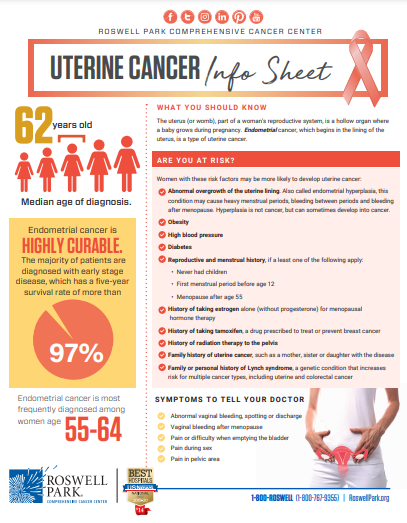
The most common type of cancer of the uterus begins in the lining (endometrium). It is called endometrial cancer, uterine cancer, or cancer of the uterus. In this booklet, we will use the terms uterine cancer or cancer of the uterus to refer to cancer that begins in the endometrium.

A different type of cancer, uterine sarcoma, develops in the muscle (myometrium). Cancer that begins in the cervix is also a different type of cancer.

Cancer Talk Blog

May is National Brain Tumor Awareness Month. To help you begin to understand this complex group of tumors, we have compiled some of the key facts, statistics and information below. Learn about the Neuro-oncology Center at Roswell Park or consult the links and sources below for more information. Brain Tumor Facts and Figures

Ask A Question

Do you have a cancer question you’d like RPCI cancer experts to address? Submit a topic for consideration.

close